

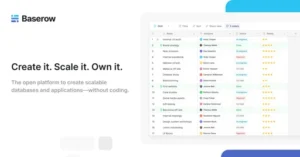
Key facts at a glance
- What it is
- Baserow is an open-source, low-code database platform that provides businesses and individuals with a visual alternative to traditional spreadsheets and database management system…
- Pricing
- from $10.00/month
- Best for
- Privacy-conscious SMBs needing self-hosted database solutions
Last updated:
Why this tool?
- Open-source database with full API-first architecture for developers
- Self-hosted option provides complete data ownership and privacy control
- No-code database builder that scales from simple tables to complex relational structures
- Real-time collaboration with built-in automation and workflow capabilities
When NOT to use?
- High-volume transactional systems: If you need to process thousands of transactions per second, Baserow's architecture isn't optimized for this scale. Consider dedicated databases like PostgreSQL or specialized transaction processing systems.
- Complex real-time analytics: For heavy analytics requiring sub-second query performance across massive datasets, data warehouses like Snowflake or BigQuery are better suited.
- Unstructured data management: If your primary need is storing large media files, documents, or unstructured content, specialized solutions like AWS S3 or document management systems are more appropriate.
- Highly customized enterprise workflows: When requiring deeply integrated, custom business logic with legacy systems, a full development framework or enterprise ERP platform may be necessary.
- Offline-first applications: Mobile apps requiring full offline functionality should use local databases like SQLite rather than cloud-based solutions.
Baserow Review: Open Source Database and Workflow Management Platform
Baserow is an open-source, low-code database platform that provides businesses and individuals with a visual alternative to traditional spreadsheets and database management systems. Accessible through a web-based interface, Baserow enables users to create, organize, and manage structured data without requiring advanced technical knowledge or coding expertise.
What is Baserow?
Baserow functions as a collaborative database builder with spreadsheet-like familiarity combined with relational database capabilities. The platform allows users to create custom tables, establish field relationships, automate workflows, and share data with team members in real-time. Its open-source nature means the source code is publicly available, and self-hosted deployment options exist for organizations requiring data sovereignty or specific infrastructure requirements.
Key Strengths of Baserow
- Open Source Architecture: Full source code transparency enables custom modifications and community contributions, distinguishing it from proprietary competitors
- No-Code Interface: Visual table creation, field configuration, and relationship mapping require no programming knowledge
- Flexible Pricing: Freemium model allows unlimited free users on self-hosted instances, making it cost-effective for growing teams
- Data Relationships: Support for linked records and relational structures enables complex data organization beyond simple spreadsheets
- Real-Time Collaboration: Multiple users can access and modify data simultaneously with instant synchronization
- Automation Capabilities: Workflow automation and formula fields reduce manual data entry and repetitive tasks
- API Access: RESTful API enables integrations with external applications and custom development
Realistic Limitations
- Learning Curve: While no-code, advanced features like database design and relationship configuration require understanding relational database concepts
- Performance Scaling: Large datasets (millions of rows) may experience slower performance compared to enterprise-grade database solutions
- Integration Ecosystem: Fewer pre-built integrations exist compared to established platforms like Airtable or Notion
- Mobile Experience: Mobile app functionality is limited; primary interaction remains web-based
- Reporting Features: Advanced analytics and visualization options are less comprehensive than dedicated business intelligence tools
- Community Support: Smaller user community means fewer third-party plugins and community-created solutions
- Enterprise Features: Advanced security, compliance, and audit logging features may be underdeveloped compared to commercial alternatives
Baserow Alternatives
Users comparing Baserow alternatives typically consider Airtable for its superior design and integration marketplace, Notion for unified workspace capabilities, or traditional databases like PostgreSQL for technical teams. The best choice depends on specific requirements: Baserow excels for open-source preference and self-hosting control, while competitors offer stronger integration ecosystems or design polish.
Best Use Cases
- Small to medium teams requiring customizable database management
- Organizations prioritizing data privacy through self-hosted deployment
- Projects with evolving data structure requirements
- Budget-conscious teams utilizing the freemium pricing model
- Technical teams comfortable with API-first approaches
Conclusion
Baserow represents a legitimate option in the low-code database platform market, particularly for organizations valuing open-source solutions and self-hosting capabilities. Its no-code interface democratizes database creation, while its limitations in performance, mobile functionality, and integration ecosystem position it better for smaller implementations than enterprise-scale deployments.
Pricing
Show price history table
| Date | Free | Premium | Advanced | Enterprise |
|---|---|---|---|---|
| Jul 2026 | $0 | $10 | $18 | Custom |
Ready to try Baserow?
Try Baserow for free and see for yourself.
Baserow vs. Alternatives
| Feature | Baserow | Airtable | Nocodb |
|---|---|---|---|
| Self-hosted deployment option | ✓ | ✗ | ✓ |
| API-first architecture | ✓ | ✓ | ✓ |
| Webhook automation | ✓ | ✓ | ○ |
| Real-time collaboration | ✓ | ✓ | ✓ |
| Conditional field visibility | ✓ | ✓ | ○ |
| Premium template gallery | ○ | ✓ | ✗ |
| Open source code access | ✓ | ✗ | ✓ |
| Advanced permissions & SSO | ○ | ✓ | ○ |
| Starting price | Free | $20/mo | Free |
✓ Supported ○ Limited ✗ Not supported
vs. Alternatives
- vs. Airtable: Open-source and self-hostable with no vendor lock-in
- vs. Notion: Purpose-built database with native API and automation workflows
- vs. Microsoft Access: Modern, collaborative, and cloud-ready alternative
Frequently Asked Questions
- What is Baserow and how does it work?
- Baserow is an open-source, low-code database platform that allows users to create custom databases and applications without coding expertise. It provides a visual interface similar to spreadsheets where you can organize, manage, and collaborate on data in real-time.
- Is Baserow free to use?
- Yes, Baserow offers a free tier with essential features for personal and small team projects. They also provide premium paid plans with advanced functionality, increased storage, and priority support for businesses with more demanding needs.
- Can Baserow be self-hosted?
- Yes, Baserow is open-source and can be self-hosted on your own servers, giving you full control over your data and infrastructure. The self-hosted version provides the same core functionality as the cloud version while allowing complete customization.
- What are the main features of Baserow?
- Baserow includes features like customizable database tables, multiple field types, filtering and sorting, collaboration tools, API access, webhooks, and integration capabilities. It also supports file uploads, real-time updates, and role-based user permissions for team management.
- How does Baserow compare to Airtable?
- Baserow is similar to Airtable in providing a user-friendly database interface but offers the advantage of being open-source and self-hostable, giving you more control and potentially lower costs. While Airtable is cloud-based with a polished interface, Baserow provides greater flexibility and data sovereignty for users who prefer self-hosting.
