

BrowserAct
Average of 1 independent sources · How we score →
Show score breakdown
| Source | Rating | Weight |
|---|---|---|
| Product Hunt | 7.2/10 | 100.0 % |
We never award a 10/10 — the composite score is capped at 9.4. A perfect headline rating would not be credible.
Ad link. If you sign up through it, we may earn a commission — your price stays the same. How we earn →
Key facts at a glance
- What it is
- BrowserAct is a no-code AI web scraping platform that lets users describe the data they need in plain language, after which an AI agent builds a reusable, tested scraping bot auto…
- Toolsplorer score
- 7.2/10 (average of 1 independent sources)
- Best for
- Solo SaaS founder who needs competitor pricing data weekly but has no scraping experience and wants a spreadsheet without writing Python
Last updated:
Why this tool?
- Prompt-to-scraper pipeline: describe the data once, AI builds a reusable Bot without writing a single line of code
- Two bot modes for every need: adaptive Agent Bots handle dynamic sites, predictable Workflow Bots ensure consistent structured output
- Managed cloud browsers with static proxies included — no separate proxy setup or headless browser infrastructure to maintain
- Improve scrapers conversationally: add new fields or fix extraction by typing a follow-up prompt, not editing code
When NOT to use?
- You need to scrape sites with aggressive anti-bot protection. BrowserAct uses static proxies, which means sites that fingerprint rotating residential IPs or require CAPTCHA solving at scale may still block your requests consistently.
- You need real-time data with sub-second latency. BrowserAct is designed for scheduled or on-demand batch runs — if your use case requires live data feeds or streaming, the cloud browser execution model adds too much latency.
- You have a very high scraping volume on a tight budget. The credit-based model means large-scale operations can exhaust credits quickly; at high volume, costs compound fast compared to self-hosted solutions like Scrapy or Playwright on your own infrastructure.
- You need to scrape authenticated apps with complex session logic. Multi-step logins, MFA, session tokens, and OAuth flows go beyond what a prompt-driven no-code agent handles reliably — these scenarios typically require custom scripted scrapers.
- Your team has strong engineering resources and wants full control. BrowserAct trades flexibility for convenience; developers who need fine-grained control over request headers, retry logic, proxy rotation, or data pipelines will hit the ceiling of a managed no-code platform quickly.
BrowserAct is a no-code AI web scraping platform that lets users describe the data they need in plain language, after which an AI agent builds a reusable, tested scraping bot automatically. It is designed for marketers, data analysts, and operations teams who need structured web data without writing code. With a G2 rating of 4.6 and AppSumo rating of 4.4, BrowserAct stands out by combining prompt-based bot creation with cloud-managed browsers and static proxies for reliable, scalable extraction.
How BrowserAct Works
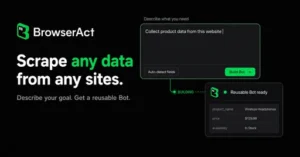
Instead of configuring selectors or writing scripts, you write a single prompt describing the data you want. BrowserAct's AI agent then navigates the target website, identifies the relevant elements, and produces a reusable bot. There are two bot types:
- Agent Bots — adaptive bots that handle dynamic or unpredictable page layouts by re-evaluating elements on each run.
- Workflow Bots — deterministic bots that follow a fixed sequence of steps, offering predictable performance for stable sites.
Once created, bots run on demand or on a schedule inside BrowserAct-managed cloud browsers. Output is delivered as structured spreadsheets, and you can refine results by asking for additional fields in natural language — no reconfiguration needed.
Pricing and Plans
BrowserAct uses credit-based pricing. All new accounts receive 200 signup credits and a 7-day free trial. Paid tiers (billed monthly / annually):
- Free — 200 credits, 2 agent builds, 2 simultaneous tasks
- Basic — $20/mo or $13/mo billed yearly, 10,000 credits, 10 simultaneous tasks
- Essential — $100/mo or $56/mo billed yearly, 50,000 credits, 20 simultaneous tasks
- Advanced — $200/mo or $96/mo billed yearly, 100,000 credits, 40 simultaneous tasks
- Custom — tailored plans for enterprise volumes
Annual billing cuts costs by roughly 35–52 % depending on the tier, making the Basic plan particularly accessible for individuals or small teams exploring AI-driven scraping.
Integrations and Alternatives
BrowserAct connects to external workflows through a REST API, MCP servers, and a CLI. It also plugs into popular automation platforms including n8n, Make, and Zapier, which makes it straightforward to feed scraped data into CRMs, databases, or reporting dashboards without manual exports.
Compared to alternatives like Apify, Octoparse, or Browse AI, BrowserAct's differentiator is its prompt-first approach: there is no visual point-and-click setup. This is faster for users comfortable with natural-language instructions but may feel less transparent for those who prefer visual selector mapping. Apify offers a larger marketplace of pre-built scrapers, while Octoparse provides a desktop app with a visual workflow designer. Bright Data and Firecrawl focus more on proxy infrastructure and raw crawling, respectively, whereas BrowserAct bundles proxy management into its managed cloud browsers.
Bottom Line
BrowserAct is a strong option for teams that need recurring, structured web data without developer resources. The AI-driven bot builder removes the setup friction common in traditional scraping tools, and the credit-based model keeps costs proportional to usage. The free tier and 7-day trial provide enough room to test whether its prompt-based workflow fits your data collection needs before committing to a paid plan.
Ready to try BrowserAct?
Try BrowserAct for free and see for yourself.
Ad link. If you sign up through it, we may earn a commission — your price stays the same. How we earn →
BrowserAct vs. Alternatives
| Feature | BrowserAct | Browse AI | Apify |
|---|---|---|---|
| No-code AI bot builder | ✓ | ✓ | ✗ |
| Cloud-managed browsers with proxies | ✓ | ✓ | ✓ |
| Scheduled scraping runs | ✓ | ✓ | ✓ |
| REST API & MCP server integration | ✓ | ○ | ✓ |
| Workflow tool connectors (n8n, Make, Zapier) | ✓ | ✓ | ✓ |
| Adaptive AI agent bots | ✓ | ✗ | ✗ |
| Structured spreadsheet export | ✓ | ✓ | ✓ |
| Free tier included | ✓ | ✓ | ✓ |
✓ Supported ○ Limited ✗ Not supported
vs. Alternatives
- vs. Apify: BrowserAct requires no JavaScript or SDK knowledge — one prompt replaces actor development for non-developers
- vs. Browse AI: BrowserAct's Agent Bot mode handles dynamic, JS-heavy sites more adaptively than rule-based recorder flows
- vs. Octoparse: BrowserAct is cloud-native with managed proxies included; Octoparse requires local agent installation for many tasks
- vs. Firecrawl: BrowserAct targets structured spreadsheet output for business users; Firecrawl targets markdown/LLM-ready text for developers
- vs. Bright Data: BrowserAct bundles browser + proxy + AI into one credit-based plan; Bright Data charges proxy and scraping infrastructure separately
Frequently Asked Questions
- How much does BrowserAct cost per month?
- BrowserAct starts at $20/month (Basic) and goes up to $200/month (Advanced), with discounted annual billing dropping those to $13 and $96/month respectively. All plans are credit-based: Basic includes 10,000 credits, Essential 50,000, and Advanced 100,000; custom enterprise plans are also available.
- Does BrowserAct have a free plan or free trial?
- Yes — BrowserAct offers both a free tier and a 7-day free trial. The free plan gives new users 200 signup credits and allows up to 2 agent builds and 2 simultaneous tasks, making it enough to test the platform on small scraping jobs before committing to a paid plan.
- What is BrowserAct best used for?
- BrowserAct is best suited for non-developers and data teams who need to extract structured data from websites at scale without writing code. Its prompt-driven Bot builder is especially useful for recurring data collection tasks like price monitoring, lead generation, and market research, where a reusable, scheduled scraper saves significant manual effort.
- How does BrowserAct compare to Apify or Browse AI?
- BrowserAct differentiates itself with a fully no-code, prompt-first workflow — you describe what you want in plain language and the AI builds a tested Bot automatically, whereas Apify leans toward developers writing actors in code and Browse AI offers a similar no-code approach but with less AI autonomy in bot construction. BrowserAct also bundles managed cloud browsers with static proxies, removing the need to configure separate proxy services as required with Bright Data or Firecrawl.
- What integrations does BrowserAct support?
- BrowserAct integrates via a REST API, MCP servers, and a CLI, as well as natively with popular workflow automation tools including n8n, Make (formerly Integromat), and Zapier. This means scraped data can be piped directly into spreadsheets, databases, or downstream automations without additional middleware.
- What are the task and credit limits on BrowserAct plans?
- Simultaneous task limits range from 2 on the free tier to 10 (Basic), 20 (Essential), and 40 (Advanced). Credit consumption depends on the complexity and length of each scraping run; the free plan's 200 signup credits cover only lightweight testing, while the $20/month Basic plan's 10,000 credits support moderate recurring workflows.
- Is BrowserAct worth it for web scraping?
- BrowserAct is well-regarded, holding a 4.6 on G2 and 4.4 on AppSumo, and is worth considering if your priority is speed of setup over custom code control. The AI-generated, reusable Bots and built-in proxied cloud browsers eliminate the most common scraping pain points, though heavy-volume enterprise users should evaluate credit costs carefully against alternatives like Apify that offer more programmatic flexibility.
