

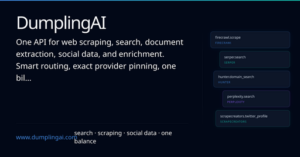
DumplingAI
Ad link. If you sign up through it, we may earn a commission — your price stays the same. How we earn →
Key facts at a glance
- What it is
- DumplingAI is a unified web-data API platform designed for AI agents and developers who need reliable access to web scraping, search, document extraction, social media data, and e…
- Pricing
- from $40.00/month
- Price tracking
- checked monthly since September 2026, last in October 2026 (2 snapshots); no verified price change
- Best for
- AI agent developer who needs reliable real-time web data without ops overhead
- Deal
- 20% off the first payment with code DOMINIK
Last updated:
Why this tool?
- Single unified balance replaces juggling 5+ separate scraping vendor subscriptions
- Intelligent provider routing automatically picks the highest-success-rate source per request
- Exact provider pinning gives developers reproducible, auditable data pipelines
- Purpose-built for AI agent workflows — not a general scraping tool bolted onto an LLM
When NOT to use?
- You only need a single, well-defined data source at high volume. If your pipeline exclusively calls one provider — say, the Google Search API — going through DumplingAI's routing layer adds cost and abstraction with no reliability benefit over a direct integration.
- Your team has no developers. DumplingAI is a raw API platform built for engineers; there is no no-code interface or visual workflow builder, so non-technical users cannot operate it without writing code or building integrations.
- You work under strict data-residency or compliance requirements. Because requests are intelligently routed across multiple third-party data providers, it is harder to audit exactly where data travels — a problem for GDPR-sensitive, healthcare, or financial workflows that require documented data provenance.
- You need sub-second, real-time response times for latency-critical systems. Web scraping and enrichment APIs are built for throughput, not millisecond latency; use cases like live trading signals or real-time fraud scoring require a fundamentally different infrastructure.
- Your data needs are entirely internal and require no live web data. If you process only first-party data — databases, CRM exports, internal documents — a unified web-data API solves a problem you do not have.
DumplingAI is a unified web-data API platform designed for AI agents and developers who need reliable access to web scraping, search, document extraction, social media data, and enrichment — all through a single endpoint. Rather than juggling multiple vendor subscriptions and API keys, DumplingAI consolidates these capabilities behind one API with intelligent request routing across data providers.
Core Capabilities and How It Works
The platform addresses a common pain point in AI-agent development: sourcing structured web data reliably without managing a patchwork of specialized providers. DumplingAI routes each request through multiple underlying data sources, selecting the provider most likely to return a successful result for the given task.
- Web scraping: Extract content from websites with built-in handling for JavaScript rendering and anti-bot protections.
- Search: Programmatic search queries that return structured results, useful for retrieval-augmented generation (RAG) pipelines and agent tool-use patterns.
- Document extraction: Pull structured data from PDFs, spreadsheets, and other file formats via API call.
- Social media data: Access public social-media content for monitoring, research, or enrichment workflows.
- Enrichment: Augment records with additional metadata — company info, contact details, or domain intelligence.
- Provider pinning: When a specific upstream source is required, developers can pin requests to an exact provider rather than relying on smart routing.
Pricing and Developer Experience
DumplingAI uses consumption-based pricing with a unified balance. There is a free tier available, which lets developers test endpoints and build prototypes before committing spend. Since all services draw from one balance, there is no need to track separate quotas across scraping, search, and enrichment — a meaningful simplification for teams running multi-step data pipelines.
The single-API approach reduces integration overhead. Instead of maintaining client libraries, authentication flows, and error-handling logic for each data vendor, teams interact with one consistent interface. Smart routing also provides a degree of fault tolerance: if one underlying provider fails or returns incomplete data, DumplingAI can fall back to an alternative source transparently.
Use Cases and Limitations
DumplingAI fits well into workflows where AI agents need to gather, verify, or enrich data from the open web — lead enrichment, competitive monitoring, content aggregation, and automated research. It is particularly relevant for teams building autonomous agents that call external tools, since a single API key covers a wide surface area of data-access needs.
There are trade-offs to consider. Abstraction layers like smart routing can obscure which upstream source actually served a response, which matters when data provenance or freshness guarantees are critical. Consumption-based pricing is transparent, but costs can be unpredictable for high-volume batch jobs compared to flat-rate alternatives. Teams with very specific scraping requirements — such as authenticated session handling or highly targeted crawl schedules — may still need a dedicated scraping provider alongside DumplingAI.
For developers and AI-agent builders evaluating a DumplingAI alternative, comparable platforms include Apify (broader scraping marketplace), ScrapeOps (proxy and scraping API management), and Bright Data (large-scale data collection). Each offers different depth in specific areas, while DumplingAI differentiates through its unified, routing-first approach that prioritizes simplicity and reliability over granular provider control.
DumplingAI occupies a practical niche for teams that want consolidated web-data access without vendor sprawl. The free tier makes evaluation straightforward, and the single-balance model keeps billing simple as usage scales across multiple data types.
Pricing
Show price history table
| Date | Starter | Pro | Business |
|---|---|---|---|
| Sep 2026 | $40 | $124 | $249 |
| Oct 2026 | $40 | $124 | $249 |
We check this pricing page every month and verify every apparent change against the Internet Archive. See how 227 tools moved in the SaaS Pricing Index →
Ready to try DumplingAI?
Try DumplingAI for free and see for yourself.
Ad link. If you sign up through it, we may earn a commission — your price stays the same. How we earn →
DumplingAI vs. Alternatives
| Feature | DumplingAI | Apify | ScrapingBee |
|---|---|---|---|
| Unified multi-provider API | ✓ | ○ | ✗ |
| Smart request routing across providers | ✓ | ✗ | ✗ |
| Web scraping | ✓ | ✓ | ✓ |
| Search API (Google, Bing, etc.) | ✓ | ✓ | ✗ |
| Document/PDF extraction | ✓ | ○ | ✗ |
| Social media data access | ✓ | ✓ | ✗ |
| Built-in data enrichment | ✓ | ○ | ✗ |
| Consumption-based pricing with free tier | ✓ | ✓ | ✓ |
✓ Supported ○ Limited ✗ Not supported
vs. Alternatives
- vs. Apify: DumplingAI is a routing API, not a marketplace of actors — zero actor maintenance
- vs. ScrapingBee alone: adds search, social data, and enrichment that ScrapingBee doesn't cover
- vs. managing SerpAPI + Diffbot + Bright Data separately: one balance, one key, one integration point
- vs. Browserless: DumplingAI abstracts provider selection; Browserless exposes raw browser control
Frequently Asked Questions
- What is DumplingAI used for?
- DumplingAI is a unified web-data API platform built for AI agents and developers. It consolidates web scraping, search, document extraction, social-media data access, and enrichment behind a single API endpoint, so teams can retrieve structured web data without managing multiple vendor subscriptions. It is particularly suited to powering AI agent pipelines that need reliable, real-time data from across the web.
- How does DumplingAI's smart routing work?
- DumplingAI automatically routes each data request across multiple underlying data providers to maximize success rates and reliability. If one provider fails or returns low-quality data, the platform retries with another without any extra code on the developer's side. Teams can also pin specific providers when they need exact, reproducible sources.
- Does DumplingAI have a free tier?
- Yes, DumplingAI offers a free tier that lets developers explore the API and test its capabilities before committing to a paid plan. Paid usage is consumption-based and billed from a single unified balance, so teams only pay for what they actually use across all data types — scraping, search, enrichment, and social data alike.
- What types of data can I access through the DumplingAI API?
- Through a single API, DumplingAI provides access to web scraping, web search results, document extraction (PDFs, structured pages), social-media data, and enrichment services. This breadth makes it a one-stop data layer for AI agent workflows that would otherwise require integrating and maintaining several specialized third-party APIs.
- How is DumplingAI different from using individual scraping APIs?
- Unlike managing separate vendor contracts for scraping, search, and enrichment, DumplingAI unifies all of those capabilities under one API key and one bill. Its intelligent routing layer also improves overall reliability by switching providers on failure, something teams would otherwise have to build themselves. This reduces integration overhead and lowers the risk of data gaps in production AI agent pipelines.
