

Credit Repair Cloud wins for managing multiple clients. It functions as a full business operating system, covering client onboarding, dispute automation, billing, affiliate management, and white-labeling under one roof. DisputeBee is a focused dispute letter tool that works well for individuals and small operations but hits a ceiling fast when client volume grows.
The core difference comes down to scope. DisputeBee automates the dispute writing process with pre-written templates and an intelligent letter writer, making it genuinely easy to generate credible letters for Equifax, TransUnion, and Experian. Credit Repair Cloud does that too, but it also handles CloudMail (built-in mailing and tracking), IdentityIQ integration for one-click credit report imports, team collaboration, and a white-label portal your clients log into under your brand.
| Software | Best For | Pricing | Key Features | Ease of Use | Scalability | Integrations | Support |
|---|---|---|---|---|---|---|---|
| Credit Repair Cloud | Scaling multi-client agencies | Tiered plans | CRM, CloudMail, white-label, AI letters, billing | Moderate learning curve | High | IdentityIQ, Zapier, API | Training, community, templates |
| DisputeBee | Individuals and small businesses | $39/mo (business) | Dispute letters, tracking, bulk mail | Very easy | Low to moderate | Zapier, e-contract, API (business) | Knowledgebase, tutorials |
| ScoreCEO | Small to mid-size businesses | Not publicly listed | Client management, dispute automation | Moderate | Moderate | — | — |
| Credit Detailer | Flexible dispute workflows | Not publicly listed | Dispute management, client tracking | Moderate | Moderate | — | — |
| Credit Money Machine | Startups and growing ops | Not publicly listed | Dispute automation, business tools | Easy | Moderate | — | — |
| Credit Versio | Integrated communications | Not publicly listed | CRM, client communication | Easy | Moderate | — | — |
| Client Dispute Manager | Detailed dispute tracking teams | Not publicly listed | Dispute management, reporting | Moderate | Moderate | — | — |
If you are just starting out and want to repair your own credit or handle a handful of clients, DisputeBee gets you moving quickly. Once you are managing a real client roster and need your brand on everything, Credit Repair Cloud is the platform built for that.

How DisputeBee and Credit Repair Cloud actually compare
The pricing gap is real and worth understanding before you commit. DisputeBee’s business plan runs $39 per month, which makes it one of the more affordable entry points in this category. Credit Repair Cloud uses tiered plans that climb with features and client capacity. The upfront cost looks higher, but the automation offsets manual work as your client count grows, which changes the real cost calculation.

Dispute letter automation is where both platforms overlap most directly. DisputeBee offers pre-written templates and an intelligent letter writer that generates dispute documents for any bureau. You select the negative item, pick a template, and the letter is ready. Credit Repair Cloud does the same with its Dispute Wizard and a Letters by AI feature that generates unique letters less likely to get flagged by bureaus. The difference is what happens after the letter is written.
DisputeBee requires you to download, print, and mail letters yourself through a service like USPS. Credit Repair Cloud’s CloudMail service handles printing, mailing, and tracking inside the platform. You choose paper quality and mailing type; CloudMail does the rest and updates your dashboard when results come in. For a business processing letters across dozens of clients, that difference in workflow is substantial.
Integration with credit report providers is another point where the two platforms diverge sharply. Credit Repair Cloud connects directly with IdentityIQ for one-click credit report imports. DisputeBee previously used IdentityIQ as well, but switched to its own credit reporting service, which has received mixed user reviews. That transition created friction for users who relied on IdentityIQ’s familiarity and reliability.
Both platforms support Zapier, which opens up connections to hundreds of other apps. DisputeBee’s business tier also includes an API and e-contract integration. Credit Repair Cloud’s integrations go further, with affiliate management tools, automated billing, and a client-facing portal that runs under your brand name.
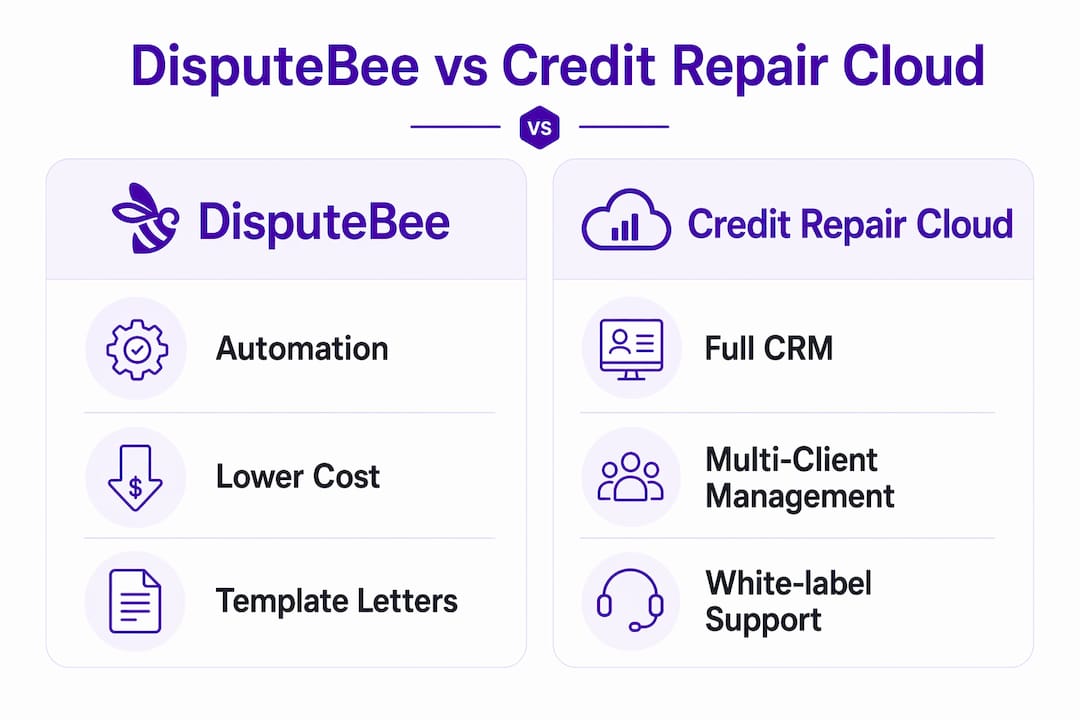
White-labeling is a clean dividing line. Credit Repair Cloud supports full white-labeling on every plan, so your clients see your brand, not the software vendor’s. DisputeBee offers no white-labeling at all. If building brand equity with your clients matters to you, that settles the question.
Pros and cons at a glance:
DisputeBee strengths:
- Very low learning curve; new users get productive fast
- Affordable entry price at $39/month for the business plan
- Clean dispute letter automation with intelligent template suggestions
- Bulk letter generation and client tracking in one dashboard
DisputeBee limitations:
- No white-labeling or affiliate management
- No built-in mailing service; manual print-and-mail required
- Credit report integration now relies on its own service with mixed reviews
- Limited team collaboration features for growing agencies
Credit Repair Cloud strengths:
- Full CRM covering onboarding, billing, disputes, and client communication
- CloudMail handles mailing and tracking without leaving the platform
- White-label portal lets clients log in under your brand
- Training, legal templates, and a private community included
- Direct IdentityIQ integration for clean credit report imports
Credit Repair Cloud limitations:
- Higher upfront cost than DisputeBee
- Takes more time to learn fully, especially Credit Repair Cloud 2.0 features
- Its own credit monitoring service (Credit Hero Score) has received mixed feedback
Pro Tip: Some professionals run both tools together via Zapier, using DisputeBee’s dispute letter engine inside Credit Repair Cloud’s broader client management workflow. It is a more complex setup, but it lets you use each platform where it is strongest.
The other platforms in this category fill specific gaps. ScoreCEO and Client Dispute Manager both target credit repair businesses that want structured dispute tracking without the full CRM overhead of Credit Repair Cloud. Credit Versio focuses on integrated client communication, making it a reasonable pick if your workflow centers on keeping clients updated. Credit Detailer and Credit Money Machine suit operators who want customizable dispute workflows or are in early growth stages and not yet ready for a full platform investment.
How to choose between DisputeBee and Credit Repair Cloud
Start with one honest question: are you running a credit repair business or repairing credit? The answer shapes everything else.
If you are handling your own credit or working with a small number of clients and your main need is generating accurate dispute letters quickly, DisputeBee fits that job. The interface is straightforward, the templates work, and the price is low enough that you are not overcommitting to a platform you may outgrow in six months.
If you are building a business, the calculus shifts. Ask yourself:
- Do you need your brand on the client portal and dispute letters?
- Will you have team members who need their own access?
- Are you planning to run an affiliate program to generate referrals?
- Do you want billing and invoicing handled inside the same system?
- Is manual mailing a bottleneck you need to eliminate?
A “yes” to any two of those points puts Credit Repair Cloud in the lead. The CRM and automation features it bundles are what allow a credit repair agency to handle a growing client roster without proportionally growing the manual workload.
One cost factor that often gets missed: manual data handling has a real price. If DisputeBee requires you to manually import credit reports, print letters, and track mailing outside the platform, that time adds up across a client base. Credit Repair Cloud’s automation offsets those hours, which changes the true cost comparison once you are past a handful of clients.
Pro Tip: Start with DisputeBee if you are testing the credit repair business model with your first few clients. Once you hit a point where manual mailing and client management feel like the bottleneck, that is the signal to move to Credit Repair Cloud, not before.
Onboarding ease matters too. DisputeBee gets you operational in a day. Credit Repair Cloud includes personalized training sessions, attorney-written legal documents, over 100 dispute letter templates, and a private community, which accelerates setup but requires a real time investment upfront. Budget for that learning curve when you make the switch.
What practitioners say about these two platforms
The clearest framing comes from credit repair educator David Forday, who positions the choice around business intent rather than features:
That framing holds up across practitioner feedback. Industry experts consistently describe DisputeBee as a point solution and Credit Repair Cloud as a business operating system. They are solving different problems, which is why comparing them purely on price or feature count misses the point.
The integration angle is where more experienced operators add nuance. Some professionals who need DisputeBee’s dispute letter precision but also need Credit Repair Cloud’s client management infrastructure connect the two via Zapier. It is not a beginner setup, but it lets each tool do what it does best.
A common mistake new users make is underestimating DisputeBee’s lack of native IdentityIQ integration. When you are handling one or two clients, manually importing credit reports is manageable. At ten or twenty clients, that manual step becomes a real drag on capacity. Scaling past manual entry is one of the most cited reasons professionals move from DisputeBee to Credit Repair Cloud.
Compliance is another area where Credit Repair Cloud’s training resources give it an edge. The Credit Repair Organizations Act (CROA) governs what credit repair businesses can and cannot do, and Credit Repair Cloud’s legal document templates and training content are built with that framework in mind. DisputeBee covers the dispute mechanics but leaves more of the compliance infrastructure to the user.
Toolsplorer helps you find the right software faster
Picking between DisputeBee and Credit Repair Cloud is one decision. Knowing which automation tools pair well with either platform, or whether a different category of software fits your workflow better, is a different question entirely.
Toolsplorer aggregates reviews, feature lists, and pricing across hundreds of software tools using an AI-driven scoring system, so you get a data-backed comparison without spending hours reading vendor marketing pages. Whether you are evaluating credit repair platforms, CRM tools, or the broader software stack for a growing business, Toolsplorer surfaces the options that actually match your use case. Browse unbiased software reviews across every category and find the tools worth your time.
FAQ
Does DisputeBee actually work?
Yes. DisputeBee generates credible dispute letters using pre-written templates and an intelligent letter writer, and it tracks disputes through your dashboard. It works well for individuals and small operations focused on the dispute process itself.
Is Credit Repair Cloud legit?
Credit Repair Cloud is a widely used CRM platform for credit repair businesses, with direct IdentityIQ integration, white-labeling, CloudMail, and bundled training resources. It is a legitimate and established platform in the credit repair industry.
How much does DisputeBee cost?
DisputeBee’s business plan is $39 per month. Credit Repair Cloud uses tiered pricing that scales with features and client capacity; specific plan prices are listed on its website.
Which platform is better for managing multiple clients?
Credit Repair Cloud is the stronger choice for multi-client management. Its CRM, CloudMail, team collaboration tools, and white-label portal are built specifically for agencies handling a growing client roster, while DisputeBee’s multi-client features are more limited.
Can you use DisputeBee and Credit Repair Cloud together?
Yes. Some professionals connect the two via Zapier to use DisputeBee’s dispute letter automation within Credit Repair Cloud’s client management workflow, though this requires more technical setup than using either platform alone.
Key Takeaways
Credit Repair Cloud is the stronger platform for multi-client credit repair businesses, while DisputeBee suits individuals and small operations focused on dispute letter automation.
| Point | Details |
|---|---|
| Platform scope | Credit Repair Cloud is a full business CRM; DisputeBee is a focused dispute letter tool. |
| Best for scaling | Credit Repair Cloud’s CloudMail, white-labeling, and team tools support growing client rosters. |
| Best entry point | DisputeBee at $39/month suits beginners testing the credit repair model with few clients. |
| Integration gap | DisputeBee no longer integrates natively with IdentityIQ, adding manual steps at scale. |
| Toolsplorer advantage | Toolsplorer compares both platforms and the broader software category with AI-driven, data-backed scoring. |