

For most HR teams, the right compensation management software comes down to three things: where your market data comes from, how cleanly it connects to your HRIS, and whether it produces an audit trail your legal team will actually accept. The short answer for 2026 is that beqom PaySuite leads for enterprise governance, Pave is the strongest fit for high-growth startups prioritizing pay equity, and CaptivateIQ wins for sales-heavy organizations running complex commission plans. If you’re mid-market and replacing spreadsheets fast, HRSoft and Aeqium both deliver structured merit workflows without the enterprise price tag.
Top three picks at a glance:
- beqom PaySuite — Centralizes salary, bonuses, equity, and incentives with audit-ready governance and multi-currency support. Best for regulated or global enterprises.
- Pave — Pay-equity analytics and startup-friendly workflows with strong benchmarking. Best for Series A–C companies building transparent pay structures.
- CaptivateIQ — Configurable commission plans with CRM integrations and transparent pay statements. Best for sales organizations with variable comp complexity.
Immediate next steps:
- Request demos from your top two or three vendors this week, not next month.
- Pull your current job architecture and HRIS export before the first demo call.
- Ask every vendor: “Show me how a manager submits a merit recommendation and how that feeds payroll.”
- Check Gartner peer reviews for your shortlisted vendors before signing.
- Confirm SOC 2 Type II certification and data residency options in writing.
Key Takeaways
The most defensible compensation management decision in 2026 combines a purpose-built governance platform, a clean HRIS integration, and a pay-equity reporting layer that satisfies U.S. Department of Labor equal-pay standards.
| Point | Details |
|---|---|
| Integration comes first | A comp platform that can’t sync cleanly with your HRIS creates more admin, not less. |
| Benchmarking source matters | Verify whether market data is live or a static annual import before shortlisting any vendor. |
| First live cycle in 6–10 weeks | A pilot merit cycle can generally be completed within a few months when job architecture is mapped first. |
| Pay-equity reporting is non-optional | DOL equal-pay guidance means audit-ready pay-equity analytics are a compliance requirement, not a nice-to-have. |
| Toolsplorer shortlists faster | Toolsplorer’s AI-driven scoring produces a tailored 3–5 vendor shortlist matched to your HRIS, size, and feature priorities. |
Table of Contents
- What does each compensation management tool actually do?
- How do you choose the right compensation platform?
- What core features should your comp platform include?
- What does implementation actually cost and how long does it take?
- How Toolsplorer scored and selected these vendors
- Toolsplorer’s take on what buyers actually get wrong
- Toolsplorer gives you a shortlist before your first vendor call
- Sources
- FAQ
What does each compensation management tool actually do?
The Gartner compensation management software market covers dozens of vendors, but the meaningful differences come down to what each platform is actually built to solve. Below is a vendor-level breakdown organized by use case.
beqom PaySuite centralizes salary, bonuses, equity, and incentives into a single governance layer with multi-currency support and full audit trails. It’s built for enterprises that need defensible documentation at scale. Implementation timelines vary depending on configuration depth.
Payfactors focuses on salary benchmarking and survey management. Its strength is feeding market data directly into planning workflows, which makes it a natural fit for compensation analysts who spend significant time on job matching and range-setting.
PayScale is the go-to for mid-market teams that need extensive salary benchmarking data without building a full compensation function from scratch. Its market-pricing tools are well-established and widely used by HR generalists.
CaptivateIQ handles commission automation with configurable plan logic and CRM integrations (Salesforce, HubSpot). Sales ops teams use it to replace manual spreadsheet calculations and give reps transparent pay statements in real time.
Pave combines compensation planning with built-in benchmarking and pay-equity analytics. Its workflows are designed for startups that want to build structured pay bands early, before comp complexity outgrows a spreadsheet.
HRSoft guides merit, bonus, and equity allocations through structured approval workflows. Mid-market HR teams use it to replace ad hoc email chains with a governed process that produces a clean audit record.
Aeqium targets organizations that have outgrown spreadsheets but aren’t ready for enterprise pricing. Its collaboration features let HR and finance work through merit cycles and equity reviews in a shared environment.
Compport automates salary reviews, variable pay, and incentive planning with direct HRIS integrations. It’s positioned for mid-market teams that want execution speed without heavy IT involvement.
SimplyMerit keeps merit review and approval routing simple. For SMBs running one or two compensation cycles per year, it removes the friction without requiring a dedicated comp analyst to configure it.
Barley focuses on pay-range configuration and transparency dashboards. Teams building pay transparency programs for the first time find it approachable; the dashboards are designed for employee-facing communication.
Complogix Compensation Management covers salary and incentive administration with flexible reporting and forecasting. Compensation administrators who need scenario modeling before budget sign-off get the most from it.
CompAnalyst (Salary.com) embeds real-time market intelligence and automated job matching directly into the planning workbook, as Salary. It’s one of the stronger options for teams that want benchmarking and planning in one interface.
CompXL takes the same approach: market data lives inside the planning workbook so managers see pay-to-market context before making recommendations. This reduces pre-planning friction and speeds cycle time.
Decusoft Compose Suite emphasizes no-code configurability and real-time reporting. HR teams that need to adjust plan logic without opening a support ticket find the no-code approach a genuine time-saver.
CompAccelerator handles merit and bonus planning for mid-market teams. It’s a solid option when the primary goal is replacing a spreadsheet-based merit process with something that has approval routing.
Deel solves a different problem: global payroll, equity, and compliance for distributed teams. If your compensation challenge is cross-border contractor and employee payments rather than merit cycles, Deel belongs on your list.
IncentiHub manages incentive programs for smaller organizations. It’s a lightweight entry point for SMBs that need structured incentive tracking without the overhead of a full compensation suite.
Incentivate focuses on sales incentive and commission tracking for SMB to mid-market teams. It’s narrower in scope than CaptivateIQ but simpler to configure for straightforward commission structures.
Labor IQ provides salary benchmarking and workforce analytics with built-in market data. HR teams that need quick, defensible salary ranges without a full benchmarking platform find it a practical starting point.
CompUp covers compensation bands and analytics for mid-market teams. Its band-management features are useful for organizations building or restructuring their pay architecture.
beqom (the broader platform, distinct from PaySuite) covers full total rewards and global governance for enterprise deployments. It’s the right conversation when total compensation strategy spans multiple countries and business units.
Pro Tip: During any demo, ask the vendor to show you a live data refresh from their benchmarking source. Static survey imports updated annually are very different from live-market signals. The difference directly affects how defensible your pay decisions are when a manager or employee challenges them.
Trust signals to verify before shortlisting:
- SOC 2 Type II certification (ask for the report, not just the badge)
- Gartner peer reviews with verified buyer status
- Published customer case studies with named organizations
- Demo recordings or sandbox access before contract signature
- Clear documentation of benchmarking data sources and refresh cadence
How do you choose the right compensation platform?
Start with data integrity and integration, not features. A platform with strong pay-equity dashboards is useless if it can’t sync cleanly with your HRIS. The U.S. Department of Labor’s equal-pay guidance formalizes the compliance stakes, which means your audit trail isn’t optional.
Prioritized evaluation checklist:
- Data integrity and job architecture — Does the platform enforce a consistent job taxonomy, or does it import whatever job titles exist in your HRIS?
- Benchmarking source and cadence — Is market data live or a static annual import? Who is the data provider?
- Pay-equity analytics — Can you run a pay-equity analysis by gender, race, and level before and after a merit cycle?
- Workflow governance — Does the platform route approvals, enforce budget guardrails, and log every change?
- Audit trail — Can you export a complete decision log for legal review?
- HRIS and payroll integration — Does it sync bidirectionally, or is it a one-way data push?
- Security and compliance — SOC 2 Type II, data residency options, role-based access controls.
- Time-to-value — Can you run a live merit cycle within 10 weeks of kickoff?
Demo questions that reveal real capability:
Integration:
- “Show me how a job change in Workday or ADP updates in your platform in real time.”
- “What happens if a payroll field doesn’t map cleanly?”
Benchmarking:
- “What is the source of your market data, and how often is it refreshed?”
- “Show me how job matching works for a non-standard job title.”
Calculations and auditability:
- “Show me the full audit log for a merit recommendation that was changed after manager submission.”
- “How does a budget overage get flagged and routed?”
Manager experience:
- “What does a manager see when they open their merit worksheet?”
- “How long does it take a first-time manager to submit recommendations?”
Red flags to watch for:
- No visible audit trail in the demo environment
- Benchmarking source described vaguely as “proprietary data” with no named provider
- HRIS sync described as “nightly batch” with no real-time option
- Implementation timeline quoted as “a few weeks” without a scoped project plan
- Vendor can’t show a live pay-equity report during the demo
What core features should your comp platform include?
Compensation management software covers six functional modules. Each solves a distinct operational problem, and not every organization needs all six on day one.
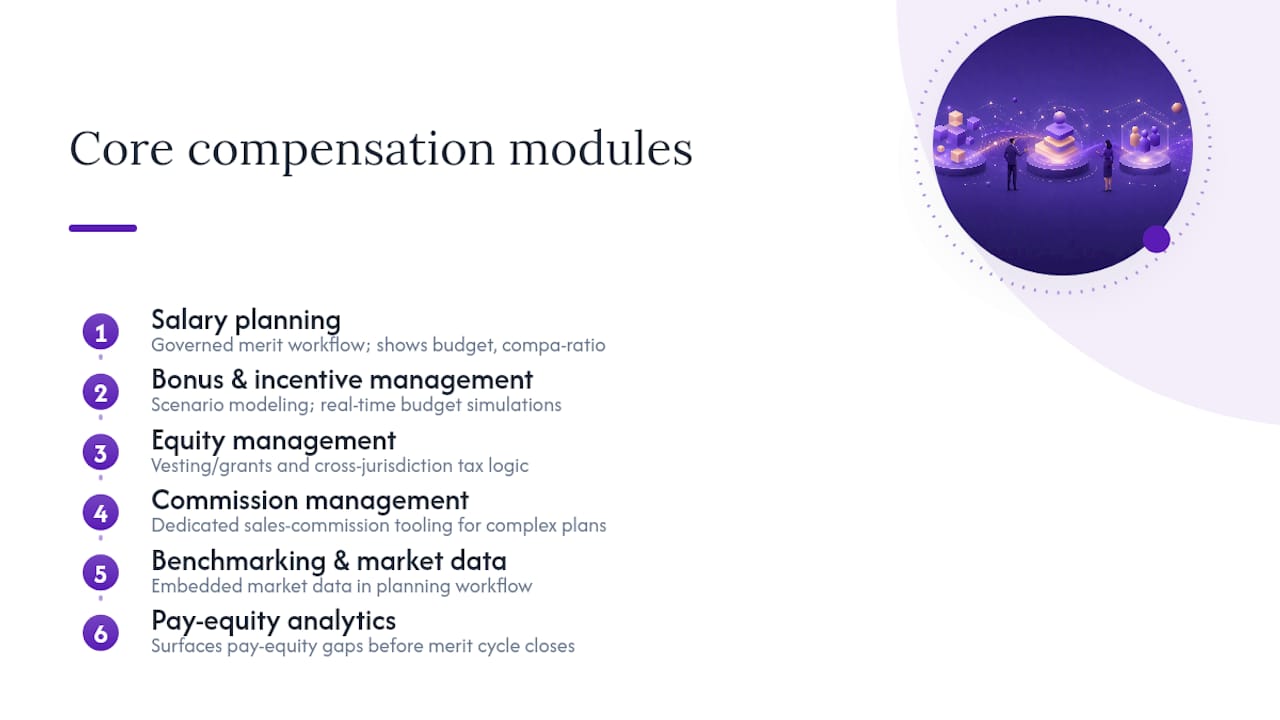
Salary planning is the foundation. It replaces the merit-cycle spreadsheet with a governed workflow where managers see budget, current pay, compa-ratio, and market position before making a recommendation. The outcome is faster cycles with fewer errors and a complete decision record.
Bonus and incentive management handles annual, quarterly, or project-based variable pay. The key capability is scenario modeling: HR and finance need to run “what if” simulations before committing budget. Platforms like Complogix and Decusoft Compose Suite offer real-time reporting that makes this practical rather than theoretical.
Equity management is where complexity spikes for growth-stage and public companies. Vesting schedules, cliff dates, grant tracking, and tax implications across jurisdictions require purpose-built logic. beqom PaySuite handles this at enterprise scale; Pave is designed for startups that want equity visibility without a full equity-administration platform.
Commission management is a separate discipline from merit planning. CaptivateIQ and Incentivate are built specifically for sales compensation, with plan configurability that general comp platforms rarely match. If your sales team runs more than two or three commission plan variants, a dedicated commission tool almost always outperforms a general platform’s commission module.
Benchmarking and market data is the feature that most buyers underestimate. Payfactors, PayScale, CompAnalyst, and Labor IQ all provide extensive built-in market data. The critical question is whether that data is embedded in the planning workflow or requires a separate export-import step. Embedding real-time market data in the planning workbook reduces pre-planning friction and gives managers defensible pay-to-market context during reviews.
Pay-equity analytics is no longer optional for U.S. employers. The DOL’s equal-pay-for-equal-work principles set the compliance floor. Platforms that surface pay-equity gaps before a merit cycle closes, rather than after, give HR teams time to correct them within budget. Pave and beqom both treat pay-equity reporting as a first-class feature rather than an afterthought.
Statistic callout: CompBldr documents that many organizations run their first live compensation cycle within 6–10 weeks of implementation when they migrate job architecture and benchmarking data before configuration begins.
Implementation complexity varies by module. Salary planning and merit workflows typically go live fastest. Equity management and commission automation require the most configuration time and the most stakeholder alignment before launch. Plan for manager training on any module that changes how they submit decisions: behavioral change is the most common reason rollouts stall.
What does implementation actually cost and how long does it take?
Treat your HRIS as the system of record and the compensation platform as the governance layer above it. That’s the architecture CompBldr describes: the HRIS holds employee data; the comp platform enforces job architecture, maps benchmarks, and documents every decision. Dayforce’s connected planning model shows how automatic payroll updates and manager guidance reduce admin when the two systems are properly integrated.
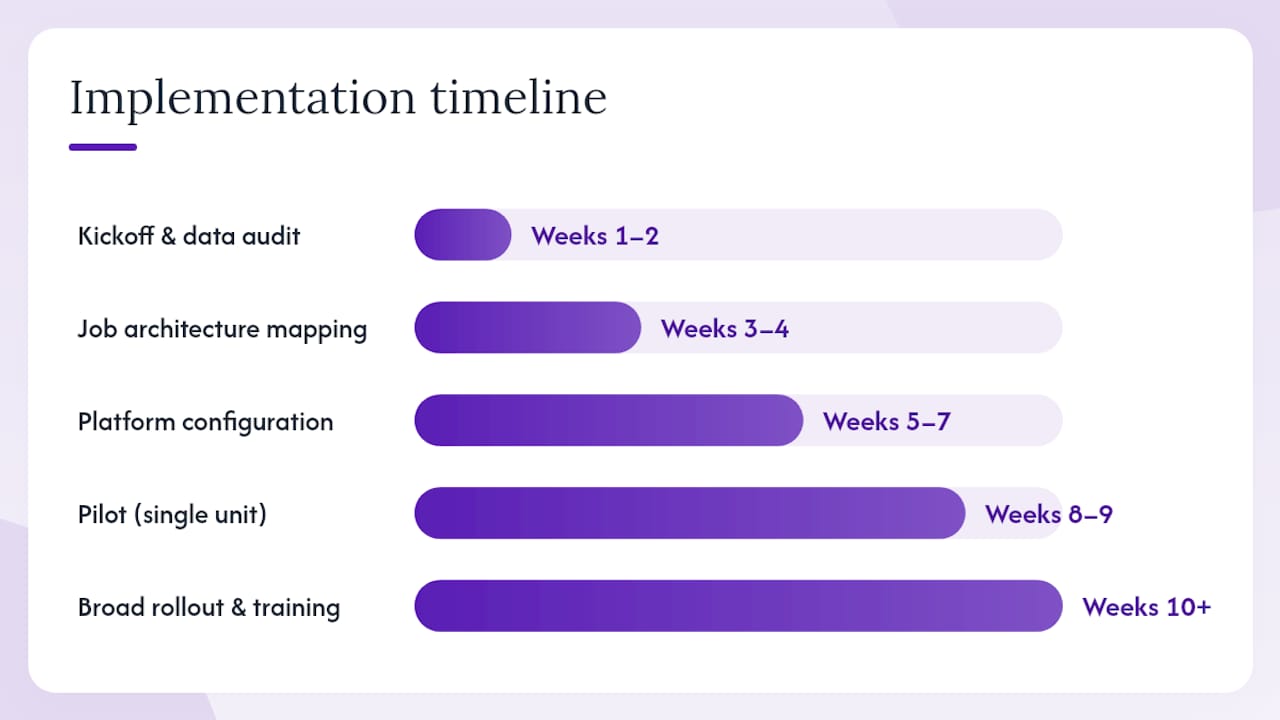
Typical implementation timeline:
- Weeks 1–2: Kickoff, stakeholder alignment, data audit (job codes, salary grades, HRIS export quality)
- Weeks 3–4: Job architecture mapping and benchmarking data load
- Weeks 5–7: Platform configuration, workflow setup, budget rules
- Weeks 8–9: Pilot with a single department or business unit
- Weeks 10+: Broad rollout, manager training, first live cycle
For HR software selection, the data-readiness phase is where most timelines slip. Job titles that don’t map to a standard taxonomy, salary grades that exist only in a spreadsheet, and HRIS fields that haven’t been maintained consistently all add weeks before configuration can begin.
Pricing shapes:
- Per-employee-per-month (PEPM): Common for SMB and mid-market tools. Predictable cost, scales with headcount.
- Per-module: Common for enterprise platforms. You pay for salary planning, equity, and commissions separately. Useful when you only need two of the three.
- Custom/negotiated: Standard for enterprise deals above a certain headcount threshold. Expect a scoping call before any pricing discussion.
A simple ROI frame: if your current merit cycle takes your HR team 200 hours of spreadsheet management per year, and a comp platform reduces that to 60 hours, the labor savings alone often cover the PEPM cost for a team of 500 employees. Add the cost of a pay-equity audit triggered by a complaint, and the governance value becomes concrete.
Stakeholder readiness checklist:
- Finance: budget approval, scenario-modeling requirements
- Payroll: integration spec, field mapping, update frequency
- IT: SSO, data security review, SOC 2 report review
- Legal/compliance: audit trail requirements, data residency
- HR operations: manager training plan, communication timeline
How Toolsplorer scored and selected these vendors
Toolsplorer’s scoring methodology measures five dimensions: product capabilities, integration depth, security posture, customer feedback quality, and time-to-value. No vendor received a placement based on marketing materials alone.
Evaluation criteria and weighting:
- Product capabilities (30%): Salary planning, bonus/incentive management, equity, commissions, benchmarking, pay-equity analytics, and reporting depth
- Integration depth (25%): Native HRIS connectors (Workday, ADP, BambooHR, Rippling), payroll sync, ATS and finance system connections
- Security and compliance (20%): SOC 2 Type II certification, data residency options, role-based access controls, audit trail completeness
- Customer feedback (15%): Verified Gartner peer reviews, published case studies, and reference customer availability
- Time-to-value (10%): Documented implementation timelines, onboarding support quality, and pilot program availability
Testing steps:
- Documentation review: product pages, security whitepapers, integration specs
- Demo scoring: structured scorecard applied to live or recorded vendor demos
- Hands-on trials: sandbox or trial access where available
- Integration checks: verification of HRIS connector documentation and API availability
Proof signals used: Gartner peer reviews, vendor case studies with named organizations, product documentation, and in-product testing where sandbox access was granted. Vendors with no verifiable SOC 2 certification or no published customer references were noted accordingly.
Toolsplorer’s take on what buyers actually get wrong
The most common mistake in a comp platform evaluation is letting a polished demo substitute for a real integration test. Vendors are skilled at showing the planning workflow in a clean demo environment with perfect data. What they rarely show unprompted is what happens when your HRIS job codes don’t match their taxonomy, or when a payroll field update fails silently.
Prioritize data governance, integration depth, and auditability over headline AI claims. A platform that promises AI-driven pay recommendations but can’t show you a clean audit log of how a recommendation was generated is a governance liability, not an asset.
The second mistake is skipping the pilot. Running a controlled merit cycle with one department in weeks 8–9 of implementation costs almost nothing in time but reveals every data and workflow gap before they affect the full organization. Vendors who push back on a pilot phase deserve scrutiny.
Toolsplorer gives you a shortlist before your first vendor call
Evaluating 21 compensation platforms takes weeks of demo calls, security reviews, and pricing negotiations. Toolsplorer cuts that to a tailored shortlist in hours, built on the same scoring framework described above.
Here’s what Toolsplorer delivers for comp platform buyers:
- A custom shortlist of 3–5 vendors matched to your organization size, feature priorities, and HRIS environment
- Side-by-side scoring on integration depth, benchmarking quality, pay-equity analytics, and security posture
- A demo scorecard and question template you can use on every vendor call
The payroll pricing comparison guide on Toolsplorer covers vendor pricing structures in detail for buyers who want to benchmark costs before entering negotiations.
Start your shortlist at Toolsplorer and get a scored comparison you can bring directly into your procurement conversation.
Sources
The claims in this article draw on the following primary sources. Each is worth bookmarking for your vendor evaluation process.
- Dol
- Compensation Management Software market — Gartner Reviews
- CompBldr — Compensation Management Software for HR & Finance
- Salary
- beqom PaySuite: Compensation Management Software
- Compensation Management & Planning Software | Dayforce
FAQ
What is compensation management software?
Compensation management software is a purpose-built platform that governs salary planning, merit cycles, bonus and incentive administration, equity tracking, and pay-equity reporting. It replaces spreadsheet-based processes with structured workflows, audit trails, and HRIS integrations.
How long does it take to implement a comp platform?
Enterprise deployments with equity and commission modules often require several months for implementation.
What’s the difference between a comp platform and an HRIS compensation module?
An HRIS compensation module stores pay data; a dedicated comp platform enforces job architecture, maps benchmarks, routes approvals, and produces a complete audit trail. Most HRIS modules don’t provide the governance depth that regulated or multi-country employers need at scale.
How do I evaluate benchmarking data quality in a vendor demo?
Ask the vendor to identify the named data provider, the refresh cadence, and how job matching works for non-standard titles. Static annual survey imports and live-market signals produce very different levels of defensibility when pay decisions are challenged.
Which compensation management tool is best for startups?
Pave is the strongest fit for startups and high-growth companies, offering built-in pay-equity analytics, real-time benchmarking, and workflows designed for organizations building pay bands before comp complexity outgrows a spreadsheet.