

CPQ software automates configuration, pricing, approvals, and quote generation so sales teams produce accurate, policy-compliant quotes faster. If you need a starting point right now, here are the three platform classes to consider:
- Toolsplorer-curated shortlist: Use Toolsplorer to compare configure price quote tools side-by-side by integration fit and implementation readiness. Best for any buyer who wants a research-backed starting point before committing to a demo.
- Lightweight CRM-embedded CPQ (HubSpot CPQ, monday CRM, QuoteWerks, PandaDoc): Best for teams under 200 reps with straightforward product catalogs and an existing CRM they want to stay inside.
- Enterprise revenue-cloud platforms (Salesforce CPQ/Agentforce Revenue Management, Oracle CPQ, SAP CPQ, ServiceNow CPQ): Best for companies with complex pricing rules, multi-entity operations, subscription billing, or engineer-to-order manufacturing.
The single biggest procurement mistake is choosing by feature count rather than by tech-stack fit. A mid-market SaaS team on HubSpot does not need Oracle CPQ. A global manufacturer running SAP S/4HANA does not need QuoteWerks.
Key Takeaways
The right CPQ platform is determined by tech-stack fit and implementation readiness, not feature count. Skipping data and rules cleanup is the single most common reason CPQ projects miss their go-live dates.
| Point | Details |
|---|---|
| Match your tech stack first | Choose CPQ that integrates natively with your existing CRM and ERP to avoid costly custom development. |
| Pre-clean product and pricing data | Audit your catalog and document every pricing rule before implementation begins. |
| Scope a focused proof-of-value | Start with one product line and one quote type to deliver measurable ROI in weeks, not months. |
| Budget for professional services | Implementation services often cost as much as or more than the software license itself. |
| Use Toolsplorer to shortlist faster | Toolsplorer’s AI-scored comparisons filter CPQ platforms by integration fit and implementation readiness before you enter a sales cycle. |
Table of Contents
- Which CPQ software fits your needs? A side-by-side comparison
- Short vendor profiles: what each platform does best
- What does CPQ software actually do?
- Who actually benefits from CPQ, and when does it pay off?
- How to choose the right CPQ platform
- What does CPQ cost, and how long does implementation take?
- How Toolsplorer selected and scored the platforms in this guide
- The CPQ implementation lesson most buyers learn too late
- Toolsplorer cuts your CPQ research time significantly
- Sources
- FAQ
Which CPQ software fits your needs? A side-by-side comparison
Gartner defines CPQ applications as tools that automate and optimize quote creation and order capture. The table below maps the leading platforms against the dimensions that actually drive procurement decisions.
Stat to know: According to practitioners, CPQ implementation is roughly 20% vendor selection and 80% data and rules cleanup — catalog standardization, pricing rule governance, and approvals mapping.
Short vendor profiles: what each platform does best
The profiles below are ordered by deployment complexity, from lightest to heaviest. Use them to confirm fit before requesting a demo.
-
Toolsplorer — Not a CPQ vendor itself, but the fastest way to build your shortlist. Toolsplorer’s AI-driven scoring aggregates user reviews and integration signals across all the platforms listed here, so you can filter by tech stack and implementation readiness before you talk to a single sales rep. Start here.
-
HubSpot CPQ — CRM-native quoting with AI-assisted template generation and direct conversion to contracts and billing records. If your team already lives in HubSpot, setup takes weeks rather than months. The trade-off: limited support for complex product configurations or multi-tier pricing logic.
-
monday CRM — A visual pipeline tool with customizable quote workflows. Lightweight CRM-embedded CPQ like monday suits teams that want quick setup and simpler quoting needs, not teams with hundreds of SKUs or approval chains.
-
QuoteWerks — One of the longest-standing SMB quoting tools, with broad CRM connectors (Salesforce, HubSpot, ConnectWise, MS Dynamics). Pricing is transparent and seat-based. It handles product catalogs and distributor price feeds well, but subscription billing and complex approval routing require workarounds.
-
PandaDoc — Proposal and document automation first, CPQ second. Strong for services firms and agencies that need branded proposals with e-signature. Not the right call for manufacturers or SaaS companies with complex pricing models.
-
NetSuite CPQ — Purpose-built for companies already running NetSuite ERP. Quote-to-order is tight because it lives inside the same data model. If you are not on NetSuite, there is no compelling reason to choose it.
-
DealHub CPQ — The standout for B2B SaaS companies managing subscription tiers and renewals. Its no-code playbook automation and DealRoom buyer collaboration portal reduce back-and-forth on complex deals. Integrates natively with Salesforce and HubSpot.
-
Conga CPQ — Pairs CPQ with contract lifecycle management, which matters when legal and sales handoffs slow down deal velocity. Runs primarily on Salesforce. If contract redlines and approval routing are as painful as quoting itself, Conga consolidates both.
-
Epicor CPQ — Visual configuration for discrete manufacturers, particularly those already on Epicor ERP. The visual configurator reduces spec errors and shortens engineering review cycles.
-
Infor CPQ — Similar visual configuration focus, but with multi-format BOM generation and stronger connectivity to Infor’s own ERP suite. Good fit for distribution-heavy operations.
-
Revalize CPQ — Targets industrial and specialty manufacturers with product-specific visual configuration and catalog management. Particularly strong in fluid power, HVAC, and process equipment verticals.
-
Cincom CPQ — Automatic BOM generation and quote-to-order automation for engineer-to-order manufacturers. Close ERP integration is the core differentiator; Cincom is built for environments where a wrong configuration creates a downstream manufacturing error, not just a pricing discrepancy.
-
SAP CPQ — The natural choice for manufacturers and distributors running SAP Sales Cloud or S/4HANA. Variant configuration models map directly to SAP’s product structure, which eliminates the translation layer that causes errors in other integrations.
-
PROS CPQ — AI-driven dynamic pricing science layered on top of CPQ. Best for companies with large, volatile catalogs where margin optimization and competitive pricing response matter as much as quote speed.
-
ServiceNow CPQ — AI-powered rule execution across omnichannel quoting and subscription lifecycle management. Suited to enterprises that already run ServiceNow for IT or operations and want to extend it into revenue workflows.
-
IBM Sterling CPQ — Omnichannel configuration across eCommerce, direct sales, and partner channels. The emphasis is on buyer experience consistency, which matters for enterprises where a partner portal and a direct rep must produce identical quotes.
-
Oracle CPQ — Cloud-based CPQ that bridges CRM and ERP with AI-assisted configuration and broad ERP connectors. The right choice for global enterprises with multi-division pricing governance, not for teams that want to be live in 90 days.
-
Salesforce CPQ / Agentforce Revenue Management — The dominant platform for Salesforce-native organizations. The product is evolving from standalone CPQ into a broader revenue lifecycle platform under the Agentforce and Revenue Management umbrella, covering renewals, usage-based billing, and revenue recognition.
-
PROS CPQ (see entry 14 above for the full profile).
What does CPQ software actually do?
CPQ stands for Configure, Price, Quote. Those three words describe a sequence, not just three features.
Configure means a rep or buyer selects product options, bundles, or variants through a guided interface. The configurator enforces product rules: incompatible components cannot be selected together, required accessories are flagged automatically, and engineer-to-order products generate a bill of materials the moment a configuration is complete. For manufacturers, this is where BOM generation and PLM/ERP integration become critical. A wrong configuration that reaches manufacturing is far more expensive than one caught at the quote stage.
Price means the system applies the correct price automatically, drawing from tiered pricing tables, customer-specific contracts, volume discounts, and margin floors. Approval workflows trigger when a rep discounts beyond a threshold. The pricing engine replaces the spreadsheet that every sales team eventually breaks.
Quote means a formatted, branded proposal document is generated from the configuration and pricing data, ready for e-signature or contract conversion. Document generation pulls from templates, so legal language, terms, and product descriptions stay consistent across every rep.
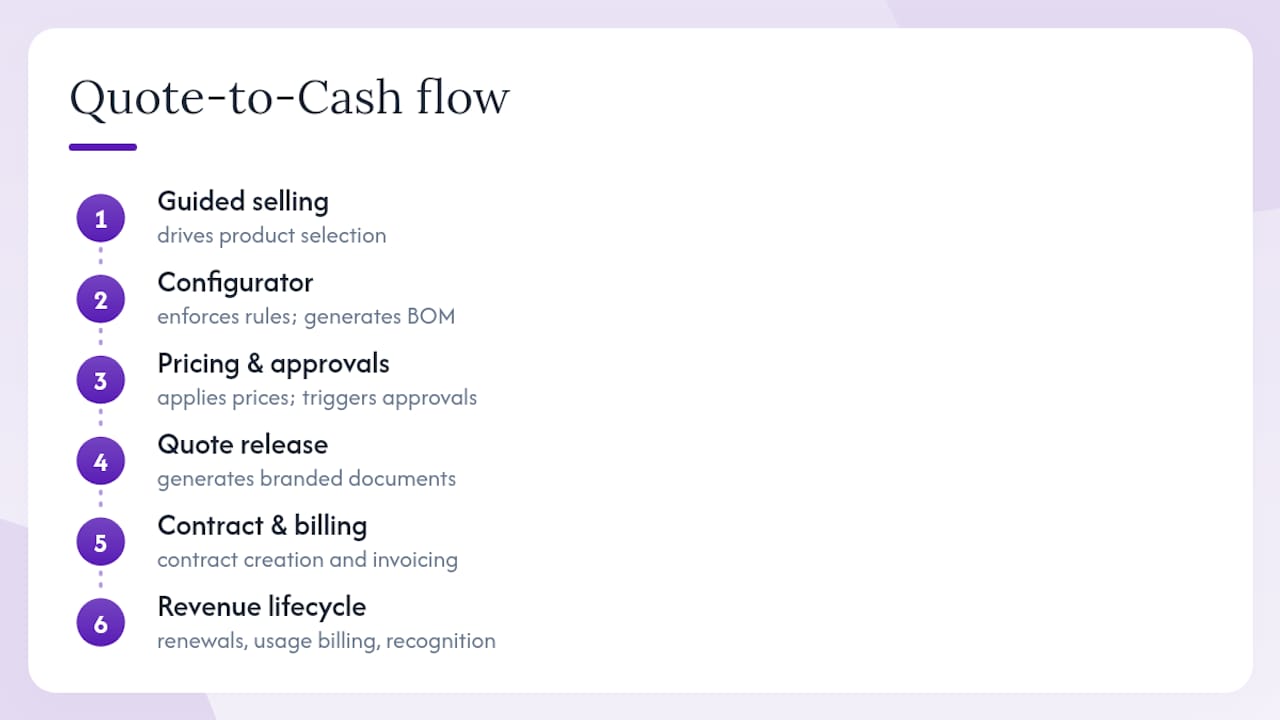
The three steps connect to a broader quote-to-cash flow: guided selling feeds the configurator, the configurator feeds the pricing engine, the pricing engine triggers approvals, approvals release the quote, and the accepted quote feeds contract creation and billing. Modern platforms like Salesforce Agentforce Revenue Management extend this further into renewals, usage-based billing, and revenue recognition, which is why CPQ adoption is increasingly driven by the need to manage the full revenue lifecycle rather than just speed up individual quotes.
Pro Tip: Map your current quote-to-cash process on a whiteboard before you evaluate any vendor. The gaps you find — missing approval steps, manual price overrides, disconnected billing — are the requirements list your RFP needs.
Who actually benefits from CPQ, and when does it pay off?
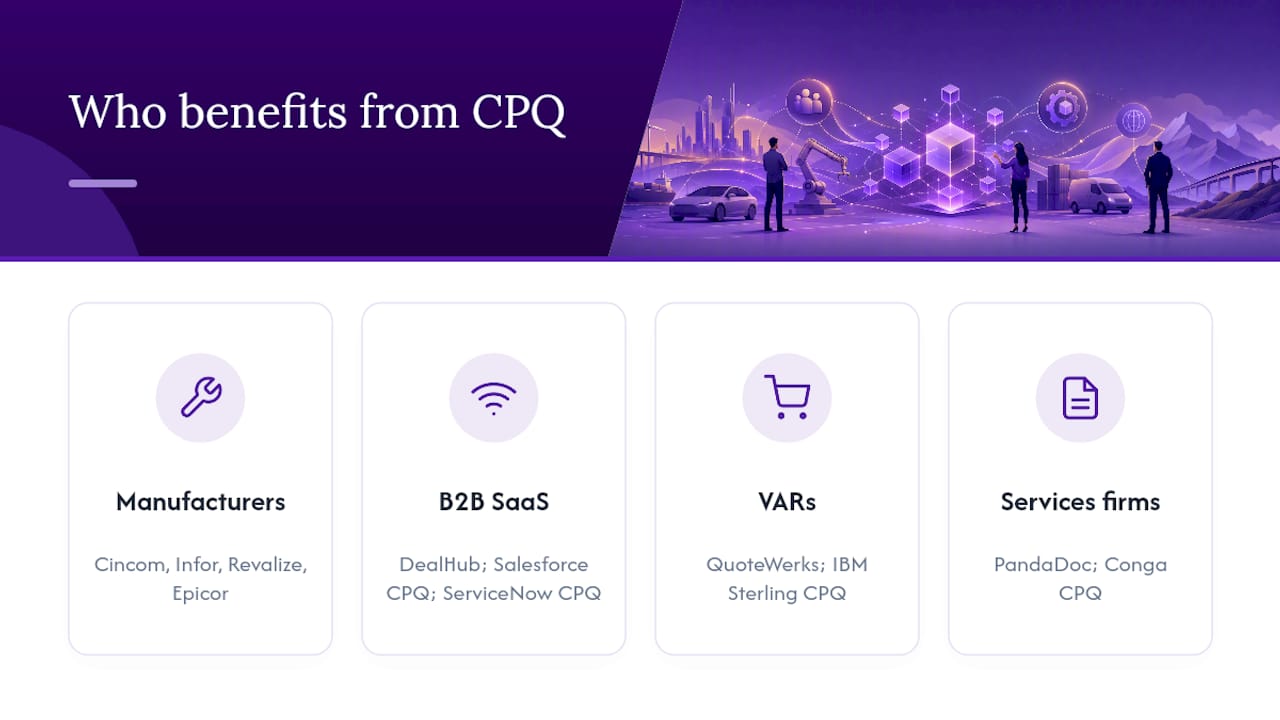
CPQ delivers the clearest ROI in four scenarios.
Manufacturers with engineer-to-order products are the most obvious case. When a product has thousands of possible configurations and a wrong spec creates a manufacturing error, guided selling and automatic BOM generation are not optional. Cincom, Infor, Revalize, and Epicor are built specifically for this motion.
B2B SaaS companies with subscription and usage-based pricing are the fastest-growing CPQ buyer segment. Subscription ramping, co-term renewals, mid-cycle upgrades, and usage overages are genuinely hard to quote accurately in a spreadsheet. DealHub, Salesforce CPQ, and ServiceNow CPQ handle these scenarios natively.
VARs and resellers managing complex bundles need CPQ to handle distributor price feeds, partner discounting rules, and multi-vendor configurations. QuoteWerks has served this market for years; IBM Sterling CPQ handles the enterprise version of the same problem across partner portals.
Services firms selling multi-year contracts benefit from CPQ when deal structures involve milestone pricing, professional services estimates, and renewal options. PandaDoc and Conga CPQ both address this, though from different angles: PandaDoc leads with document quality, Conga leads with contract lifecycle integration.
The signal that CPQ is worth the investment: your reps spend more than 20 minutes building a quote, you have had a pricing error reach a customer invoice, or your approval process lives in email threads.
How to choose the right CPQ platform
The right configure price quote software is determined primarily by tech-stack fit, not feature lists. Native CRM integrations reduce integration friction and technical debt, and that principle should anchor your evaluation.
Evaluation checklist
-
Tech-stack fit first. Which CRM and ERP do you run today? If the answer is Salesforce, Salesforce CPQ or DealHub is the short list. SAP? SAP CPQ. HubSpot? HubSpot CPQ or DealHub. NetSuite? NetSuite CPQ. Mismatched integrations add months to implementation and create ongoing sync failures.
-
Product catalog complexity. How many SKUs, variants, or configuration rules do you have? Lightweight tools handle hundreds; enterprise platforms handle millions. Be honest about where you sit.
-
Pricing model complexity. Flat list pricing, volume tiers, customer-specific contracts, and usage-based billing each require different engine capabilities. Confirm the vendor handles your specific pricing shape before the demo.
-
Approval workflow requirements. Map every discount threshold, exception type, and approver role. Ask vendors to demo approval routing with a real edge case, not a clean happy path.
-
Subscription and renewal support. If you sell recurring contracts, confirm the platform handles co-term renewals, mid-cycle amendments, and usage overages natively.
-
Admin and authoring experience. Who will maintain pricing rules and product models after go-live? If the answer is a sales ops analyst rather than a developer, no-code rule authoring is a hard requirement.
-
Vendor support and professional services. Ask for a reference from a customer with a similar tech stack and catalog size. Ask how many professional services hours their implementation actually consumed versus the original estimate.
RFP and demo questions to ask
- Show me how a rep configures a product with three incompatible options and a required accessory.
- How does the system handle a discount that exceeds the rep’s authority? Walk me through the approval routing.
- How do you handle a mid-cycle subscription amendment and a co-term renewal in the same quote?
- What does your prebuilt connector to [our CRM/ERP] cover, and what requires custom development?
- What is the typical ratio of professional services hours to license cost for a company our size?
Red flags to watch for
- A vendor who cannot demo end-to-end quote-to-bill in a single session.
- An implementation estimate with no line items for data migration and rules cleanup.
- No published customer references in your industry.
- A prebuilt connector that only syncs accounts and contacts, not product catalog and pricing.
Trust signals to verify: Gartner Magic Quadrant or Peer Insights placement, published case studies with named customers, prebuilt connectors documented in the vendor’s own help center, and a live demo of the full quote-to-bill flow. Check CRM compatibility before you commit to any platform.
What does CPQ cost, and how long does implementation take?
Typical cost bands
Pricing for CPQ software ranges from transparent seat-based fees for SMB tools to fully custom enterprise contracts. Here is a practical framework:
Professional services fees often exceed software license costs in mid-market and enterprise deployments. Budget for them from day one.
Implementation timelines
Teams that skip the prework phase consistently miss their go-live dates.
Prework checklist before any CPQ implementation:
- Audit and deduplicate your product catalog.
- Document every pricing rule, discount tier, and customer-specific contract currently in spreadsheets.
- Map every approval step, threshold, and approver role.
- Identify which ERP and CRM fields the CPQ system needs to read and write.
- Assign an internal project owner with authority to make data governance decisions.
ROI framing: If a rep currently spends significant time building a complex quote and CPQ reduces that, a team of 20 reps quoting multiple deals per week can recover substantial selling time weekly, improving efficiency. Add error reduction and margin protection from enforced discount floors, and the payback period for mid-market CPQ is typically 12–18 months.
Pro Tip: Scope your proof-of-value around one product line and one common quote type. A focused pilot delivers measurable time-to-value in weeks and builds the internal case for a full rollout far more effectively than a broad deployment that takes a year to stabilize.
How Toolsplorer selected and scored the platforms in this guide
Toolsplorer’s scoring methodology evaluates CPQ platforms across seven weighted criteria:
- Integration breadth (CRM, ERP, billing, e-signature): highest weight, because integration failure is the most common reason CPQ projects stall.
- Configurator power: ability to handle complex product rules, variants, and BOM generation.
- Pricing flexibility: support for tiered, volume, customer-specific, usage-based, and subscription pricing.
- Quote-to-cash coverage: renewals, amendments, billing handoff, and revenue recognition support.
- Ease of administration: no-code or low-code rule authoring accessible to sales ops without developer support.
- Implementation time to value: based on vendor-published timelines and customer references.
- Customer feedback: aggregated from G2, Gartner Peer Insights, and other review sources, weighted by recency and reviewer role.
Sources used in this guide include vendor product documentation, Gartner’s CPQ market data, published vendor case studies, and user reviews aggregated through Toolsplorer’s AI scoring engine. Vendor-provided claims are attributed to the vendor and cross-checked against independent user reviews where available.
Disclosure: Toolsplorer earns affiliate commissions from software referrals and may have sponsored listing relationships with some vendors featured here. Editorial rankings are determined by the scoring criteria above, not by commercial relationships. Vendors cannot purchase a higher ranking.
The CPQ implementation lesson most buyers learn too late
The most consistent pattern across CPQ evaluations: teams underestimate the internal work and overestimate what the software does on its own. A CPQ platform is a rules engine. It executes the rules you give it. If your pricing rules live in a sales director’s head and your product catalog has 400 duplicate SKUs, the platform will faithfully automate the chaos.
The practical lesson is to start smaller than you think you need to. Pick one product line, one sales channel, and one common quote type. Get that working cleanly, measure the time saved, and use that proof to fund the next phase. Teams that try to configure everything at once routinely spend 12 months in implementation and never fully adopt the tool.
AI in CPQ is genuinely useful for guided recommendations, bundle suggestions, and next-best-action prompts. But deterministic pricing rules and approval thresholds must stay governed by explicit business logic, not AI inference. The two work best together: AI surfaces options, rules enforce policy.
Toolsplorer cuts your CPQ research time significantly
Evaluating 18 CPQ vendors is a months-long project if you do it through cold outreach and vendor demos alone. Toolsplorer gives you a faster path: AI-scored, side-by-side comparisons of the best CPQ solutions filtered by the dimensions that actually matter for your situation, including integration fit, implementation complexity, and quote-to-cash coverage.
Every platform in this guide has a dedicated review page on Toolsplorer, aggregating user ratings from G2, Gartner Peer Insights, and other sources alongside verified feature and pricing data. You can filter by CRM compatibility, company size, and deployment model before you talk to a single vendor. That means your first demo is with a shortlisted vendor, not a discovery call.
Browse the full CPQ software comparisons on Toolsplorer and build your shortlist today.
Sources
Vendor documentation and analyst sources give you the ground truth that marketing decks obscure. During vendor evaluation, open these alongside any demo you attend.
Primary vendor pages give you the authoritative feature list, integration documentation, and pricing model for each platform. Analyst sources like Gartner provide independent market placement and peer review data that vendor-produced materials cannot replicate. Published implementation case studies, particularly those naming the customer and the timeline, are the most honest signal of what deployment actually looks like.
- ConfigureOne — Cloud Product Configurator
FAQ
What is CPQ software?
CPQ software automates the configure, price, quote process: it guides sales reps through product configuration, applies correct pricing and discount rules, triggers approval workflows, and generates a formatted quote document. Modern platforms extend this into the full revenue lifecycle, covering renewals, usage-based billing, and contract management.
Is Salesforce still selling CPQ?
Yes. Salesforce continues to sell CPQ, and the product is evolving into the broader Agentforce Revenue Management platform, which adds AI-assisted quoting, usage-based billing, and revenue recognition on top of the core CPQ capabilities.
Which CPQ is best?
The best CPQ depends on your tech stack. Salesforce CPQ leads for Salesforce-native organizations; SAP CPQ for SAP-stack manufacturers; DealHub for B2B SaaS with subscription pricing; HubSpot CPQ for mid-market teams on HubSpot. Use Toolsplorer’s CPQ comparisons to filter by your CRM, ERP, and company size.
Is CPQ part of Salesforce?
Salesforce CPQ is a Salesforce product, but it is a separate license from Sales Cloud. It integrates natively with Salesforce CRM and is now being consolidated into the Agentforce Revenue Management suite, which covers the full quote-to-cash and revenue lifecycle workflow.
How long does CPQ implementation take?
Lightweight CRM-embedded tools like HubSpot CPQ or QuoteWerks can go live in 2–8 weeks. Mid-market platforms typically take 3–6 months. Enterprise revenue-cloud deployments commonly run 6–18 months, with most of that time spent on data migration, pricing rules cleanup, and ERP integration rather than software configuration.