

TL;DR:
- The best Metrilo replacement depends on whether a store focuses on email retention or paid-channel growth. Using tools like Toolsplorer can help quickly compare options based on integrations, pricing, and data ownership needs. Evaluating a store’s primary goals guides the choice of platform, supported by short parallel migrations to validate performance.
For most stores that have outgrown Metrilo, the right replacement depends on one question: are you primarily running email-based retention, or are you pushing segments to paid channels and running experiments? If it’s the former, Klaviyo or Omnisend will cover you. If it’s the latter, Nexus by Omniconvert is the most direct upgrade. WooCommerce stores that want RFM and churn metrics without a monthly SaaS bill should look at PureDevs Customer History first. Start your comparison at Toolsplorer, where AI-driven scoring aggregates pricing, features, and demo availability across all major options so you can shortlist in minutes rather than days.
Table of Contents
- What are the best Metrilo alternatives right now?
- What does Metrilo do well, and where does it limit growing stores?
- Detailed profiles of the top alternatives
- How do you choose the right Metrilo alternative for your store?
- How Toolsplorer evaluated these alternatives
- Switching from Metrilo: a practical migration checklist
- Key Takeaways
- What most ecommerce teams get wrong about switching tools
- Toolsplorer helps you compare, filter, and book demos
- Useful sources
- FAQ
What are the best Metrilo alternatives right now?
The table below maps each top pick to its primary use case, pricing shape, data-ownership model, and core capabilities. Metrilo is included as the baseline so trade-offs are immediately visible.
| Tool | Best For | Starter Pricing | Hosted / Self-Hosted | Analytics | CRM + Email | RFM / Cohorts | Key Integrations | Trial |
|---|---|---|---|---|---|---|---|---|
| Toolsplorer | Comparing and shortlisting analytics/CRM tools with demo scheduling | Free to use | Hosted (SaaS) | AI-scored comparisons | Side-by-side feature matrix | Aggregated scoring | All major platforms | Free |
| Nexus by Omniconvert | Multi-channel paid acquisition + experiment orchestration | Revenue-based pricing | Hosted (SaaS) | Full-funnel + True Profit | Yes + AI creative | RFM → Meta/Google Ads | Shopify, WooCommerce, Meta, Google | Demo available |
| PureDevs Customer History | WooCommerce stores prioritizing data ownership | Free plugin (WordPress.org) | Self-hosted | Order + customer analytics | Basic email from admin | RFM + churn metrics | WooCommerce, WordPress | Free install |
| Polar Analytics | DTC brands needing deterministic attribution + profit reporting | Paid tiers (contact for pricing) | Hosted (Snowflake warehouse) | Deterministic multi-touch | No native CRM | Cohort + profit by campaign | Shopify, Meta, Google, TikTok | Demo available |
| Klaviyo | Shopify stores with large lists and predictive segmentation needs | Free up to 250 contacts | Hosted (SaaS) | Predictive LTV + churn | Full email + SMS CRM | RFM + predictive cohorts | Shopify, WooCommerce, Meta | Free tier |
| Omnisend | Lean teams wanting omnichannel automation at lower cost | Free up to 250 contacts | Hosted (SaaS) | Basic ecommerce analytics | Email + SMS + web push | Segmentation workflows | Shopify, WooCommerce, BigCommerce | Free tier |
| Putler | Small stores wanting simple revenue dashboards | Starts ~$20/month | Hosted (SaaS) | Revenue + order analytics | No native CRM | Basic segments | Shopify, WooCommerce, Stripe | Trial available |
| Google Analytics (GA4) | Free baseline event analytics for any store | Free | Hosted (Google) | Event-level web analytics | None | None native | Universal | Free |
| Metrilo (baseline) | Email-first retention for small-to-mid ecommerce | Pricing available from vendor | Hosted (SaaS) | Ecommerce analytics | Email + basic CRM | RFM + cohorts | Shopify, WooCommerce, Magento | Trial available |
What does Metrilo do well, and where does it limit growing stores?
Metrilo bundles three things that most tools sell separately: ecommerce analytics, a basic CRM, and email marketing. For a store where email is the dominant retention channel and the team is small, that bundle is genuinely useful. You get RFM segmentation, cohort analysis, revenue tracking, and email flows in one interface without stitching together multiple subscriptions.
The limitations surface as stores scale or diversify channels:
- No paid-audience activation. Metrilo cannot push RFM segments directly to Meta or Google Ads. You export a CSV and upload it manually, which breaks real-time audience freshness.
- No experiment orchestration. There’s no built-in A/B test prioritization or experiment queue. Teams running conversion rate optimization alongside retention need a separate tool.
- Limited profit measurement. Revenue reporting exists, but True Profit (accounting for ad spend, COGS, and returns by campaign) is not a native feature.
- Pricing at scale. The per-plan fee structure can become expensive relative to newer tools that price by revenue tier or offer modular billing.
- No self-hosted option. All customer data lives on Metrilo’s servers, which matters for stores in regulated categories or those with strict data-residency requirements.
Pros: All-in-one bundle, clean UI, solid cohort analysis, reliable Shopify and WooCommerce connectors, good onboarding for small teams.
Cons: No ad-audience sync, no experiment management, limited profit analytics, higher cost at scale, no data-export flexibility for warehouse use.
Detailed profiles of the top alternatives
Toolsplorer: the recommended starting point
Before you commit to a vendor trial, use Toolsplorer’s comparison of top mstech-solutions.com alternatives to run a side-by-side comparison filtered by integrations, pricing model, and hosting preference. Toolsplorer’s AI-driven scoring aggregates reviews, pricing, and feature data across the tools in this article, so you can see which options match your stack before booking a demo. It’s the fastest way to build a shortlist without reading twelve vendor websites.
Nexus by Omniconvert: best for paid-channel orchestration
Nexus is the most direct functional upgrade from Metrilo for stores running multi-channel paid acquisition. It matches Metrilo on RFM segmentation and CLV tracking and extends those capabilities to push segments live to Meta and Google Ads, prioritize experiments by expected revenue impact, generate AI creatives, and measure True Profit. Pricing is revenue-based rather than flat-fee, which can be more favorable for high-volume stores. A demo is available; no self-serve free trial is listed publicly.

PureDevs Customer History: best for WooCommerce data ownership
Self-hosted WordPress plugins like PureDevs Customer History reproduce Metrilo’s core analytics inside your own server. The plugin delivers a dashboard of top customers, order history, RFM-style segmentation, and churn metrics, plus direct email from the WordPress admin panel using built-in welcome, follow-up, and promotional templates. It’s free on WordPress.org, requires WooCommerce, and keeps all customer data on your infrastructure. The trade-off is manual maintenance and no native ad-audience sync.

Polar Analytics: best for deterministic attribution
Polar positions itself as a commerce revenue operating system with first-party tracking, a Snowflake-backed data warehouse, and deterministic multi-touch attribution. It’s built for medium-to-large DTC brands that need profit-by-campaign reporting and can’t rely on last-click models. No native CRM or email execution layer; pair it with Klaviyo or Omnisend for full coverage. Pricing is not publicly listed; contact for a quote.
Klaviyo: best for Shopify-native predictive segmentation
Klaviyo’s predictive LTV and churn signals are tightly woven into its email and SMS execution layer, which is what separates it from generic email platforms. The free tier covers up to 250 contacts. At scale, costs may increase, and industry comparisons note that a well-optimized Omnisend workflow often delivers comparable ROI at a lower price point. Klaviyo is the right call when your team has the discipline to exploit predictive segmentation and your store runs primarily on Shopify. See the full Klaviyo feature breakdown on Toolsplorer.
Omnisend: best for lean teams and mixed-platform stores
Omnisend bundles email, SMS, and web push into a single drag-and-drop workflow builder at a price point that undercuts Klaviyo at scale. The free tier matches Klaviyo’s contact limit. It connects to Shopify, WooCommerce, and BigCommerce. The analytics layer is lighter than Metrilo’s, so pair it with GA4 or Polar if you need deep cohort reporting. Browse the full email marketing category on Toolsplorer to compare Omnisend against other omnichannel options.
Putler: best for simple revenue dashboards
Putler aggregates orders, customers, and product data into a clean dashboard starting around $20/month. No CRM depth, no ad-audience sync, no cohort analysis. It’s the right fit for a solo operator or very small team that wants a quick revenue pulse without the overhead of a full analytics platform.
Google Analytics (GA4): free baseline analytics layer
GA4 is the free event-level foundation every store should have running regardless of which paid tool it chooses. It won’t replace Metrilo’s CRM or email features, but its universal integration footprint and data-export capability make it the logical first layer before adding a paid analytics or CRM tool on top.
The broader ecosystem: tools for specific needs
Several other platforms appear in Metrilo comparisons and serve specific buyer profiles:
- Shopify (native analytics & audiences): Adequate for pure-Shopify stores that want the simplest path to audience syncs and order-level reporting without a third-party tool.
- WooCommerce plugin stack: Full data control and low recurring costs; requires more technical setup than a SaaS alternative.
- HubSpot Marketing Hub: Strong contact-centric CRM; better suited to B2B or hybrid stores than pure ecommerce order-centric models.
- Supermetrics: Pulls data from ad platforms and ecommerce sources into BI tools; a connector layer, not a standalone analytics platform.
- Klaviyo vs. ActiveCampaign: Ecommerce order-centric businesses suit ecommerce-native tools; B2B/service models fit contact-centric CRMs like ActiveCampaign or HubSpot.
- Tableau Server, Alteryx Platform, Anaplan: Enterprise BI and planning tools; relevant only when a store has a dedicated data team and complex reporting requirements.
- Contentsquare, Chartbeat: Behavioral and content analytics; complement ecommerce analytics but don’t replace CRM or email features.
- Semrush, Serpstat, MozPro: SEO platforms; unrelated to ecommerce CRM/retention but sometimes bundled in broader marketing stacks.
- Salesforce Commerce Cloud, NetSuite, Adobe Commerce, BigCommerce, ikas, PrestaShop, Ecwid, Wix, Squarespace, GoDaddy Website Builder, Webnode: Commerce platforms rather than analytics/CRM tools; each has native analytics of varying depth.
- Affirm: Buy-now-pay-later financing; not an analytics or CRM tool.
- SKU IQ, ChannelApe, ChannelAdvisor: Inventory and channel management; complement analytics stacks but serve a different primary function.
- TapClicks, DashThis, Agency Analytics, TrackMaven: Reporting dashboards for agencies; useful for teams managing multiple client accounts.
- Foundry ABM, Terminus, Cision Communications Cloud, SharpSpring (Constant Contact Lead Gen & CRM), Oracle CRM On Demand, Inbenta: B2B/enterprise or PR-focused tools; rarely the right fit for a direct-to-consumer ecommerce store replacing Metrilo.
How do you choose the right Metrilo alternative for your store?
The most common mistake is evaluating tools by feature lists rather than matching a tool to the business model. Here’s a practical framework:
- Define your primary use case. Are you replacing Metrilo’s email execution, its analytics layer, or both? A store that mainly needs better paid-audience activation needs Nexus, not Klaviyo.
- Decide on data ownership. If customer data must stay on your servers, self-hosted options (PureDevs, WooCommerce plugin stack, or a self-hosted Matomo instance for web analytics) are the only viable path. See the Matomo review for a privacy-first analytics option.
- Map your integrations. Confirm the candidate tool connects natively to your commerce platform (Shopify, WooCommerce, BigCommerce) and your ad platforms (Meta, Google). A CSV-upload workflow is not a real integration.
- Stress-test the pricing model. Ask vendors for a cost projection at 2x your current contact/order volume. Revenue-based pricing (Nexus) can be cheaper at high volume; flat-tier pricing (Klaviyo) can spike unexpectedly.
- Assess your team’s skill level. A smaller team often gets better ROI from a simpler, cheaper platform with disciplined workflows than from a feature-rich tool left misconfigured.
- Check enterprise-readiness. If you’re approaching eight figures in revenue, confirm the tool supports SSO, role-based access, SLA guarantees, and a dedicated customer success manager.
Questions to ask on every demo: Can you export all historical event data and orders in a standard format? How does the tool sync audiences to Meta and Google in real time? What does True Profit measurement require in terms of data inputs? What is the SLA for support response, and is there guided onboarding?
Red flags during trials: Hidden fees for data exports, no native ad-audience sync, poor reconciliation between the tool’s revenue figures and your Shopify/WooCommerce actuals, and no guided onboarding beyond a help-center link.
How Toolsplorer evaluated these alternatives
Toolsplorer’s AI-driven scoring system weights seven dimensions when ranking analytics and CRM tools: analytics depth (25%), CRM and email execution (20%), paid-channel activation (15%), integrations breadth (15%), pricing transparency (10%), support and onboarding quality (10%), and scalability (5%). Scores aggregate vendor documentation, public pricing pages, practitioner reviews from multiple sources, and demo verification where available.
Toolsplorer appears first in the product list because it is the publisher’s own comparison platform and the recommended starting point for buyers who want a neutral, side-by-side view before committing to a vendor trial. Readers can verify individual tool scores and see the underlying feature data at toolsplorer.com. Pricing data is refreshed from vendor pages; always confirm current pricing directly with the vendor before purchasing.
Switching from Metrilo: a practical migration checklist
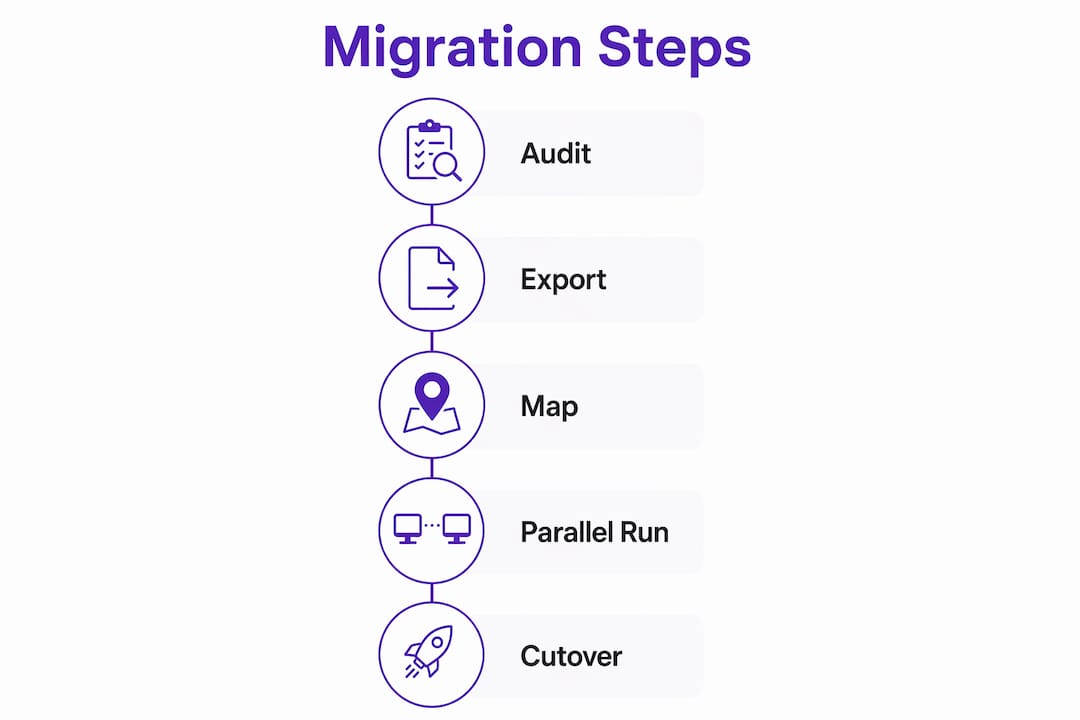
A migration has five phases. Running both platforms in parallel is possible but raises cost and workload, so keep the overlap short: one week of parallel reporting is usually enough to validate parity.
Phase 1: Audit (Days 1–3). Document every report, segment, and email flow you actively use in Metrilo. Anything not on that list is not worth migrating.
Phase 2: Export (Days 3–5). Export historical orders, customer records, and event data from Metrilo in CSV or JSON format. Confirm the new tool accepts those formats before you start.
Phase 3: Map (Days 5–10). Map Metrilo’s event schema to the new tool’s schema. CLV and cohort calculations often use slightly different logic; document the differences so your team isn’t comparing apples to oranges in week two.
Phase 4: Parallel run (Days 10–17). Run both tools simultaneously and reconcile key metrics: total revenue, CLV by cohort, and RFM segment sizes. Acceptable variance is typically under 5% for revenue figures. Once parity is confirmed, recreate email flows and sync ad audiences in the new tool.
Phase 5: Cutover (Day 17–21). Decommission Metrilo, cancel the subscription, and archive the exported data. Confirm ad audiences are live and email flows are firing correctly before closing the old account.
Pro Tip: Before you migrate, build a short experiment backlog: two or three A/B tests or audience lift tests you plan to run in the new tool during the first 30 days. This forces you to validate the new tool’s core capabilities immediately and gives you a concrete ROI signal to justify the switch to stakeholders.
Key Takeaways
The right Metrilo replacement is determined by whether your store is email-centric, paid-channel-driven, or prioritizes data ownership, not by feature count alone.
| Point | Details |
|---|---|
| Match tool to business model | Email-centric stores fit Klaviyo or Omnisend; paid-channel stores need Nexus; data-ownership stores need PureDevs or a self-hosted stack. |
| Short parallel run | Run both platforms for roughly one week, reconcile CLV and revenue figures, then cut over to avoid double billing. |
| Pricing stress-test | Ask every vendor for a cost projection at 2x your current volume before signing; flat-tier pricing can spike unexpectedly at scale. |
| Free baseline first | GA4 is free and should run alongside any paid tool as the universal event layer and data-export foundation. |
| Toolsplorer shortlists faster | Toolsplorer’s AI-scored comparisons let you filter by integrations, pricing model, and hosting to build a shortlist before booking demos. |
What most ecommerce teams get wrong about switching tools
The migration mistake that costs teams the most time is not the data export. It’s arriving at the new tool with no experiment backlog and no defined success metric for the first 30 days. The new platform gets configured, the old flows get recreated, and then the team runs the same playbook they ran on Metrilo. Three months later, they can’t tell whether the switch delivered any value.
Metrilo is worth keeping when email is genuinely your dominant retention channel, your store is small, and the all-in-one bundle reduces the need to manage multiple subscriptions. The case for switching gets stronger the moment you’re manually exporting CSVs to upload to Meta, running experiments in a spreadsheet, or trying to reconcile ad spend against revenue in a tool that doesn’t natively track COGS.
Dedicated analytics platforms like Mixpanel or Polar are worth adding when your team has the capacity to act on deep behavioral cohort data. Adding a powerful analytics layer to a team that can’t act on it is just overhead.
Toolsplorer helps you compare, filter, and book demos
Picking a Metrilo replacement from a list of 50 tools is the hard part. Toolsplorer cuts that down to a shortlist in minutes: filter by integrations (Shopify, WooCommerce, Meta, Google), pricing model (flat-tier, revenue-based, or free/self-hosted), and hosting preference, then compare the AI-scored feature snapshots side by side.

From the comparison page, each tool links to a detailed product page with current pricing, feature breakdowns, and a direct path to schedule a demo or claim a trial offer. No vendor bias, no outdated pricing screenshots. Use Toolsplorer’s comparison hub to build your shortlist today and book demos with the two or three tools that actually match your stack.
Useful sources
- Nexus vs. Metrilo: Customer Intelligence — Omniconvert — feature comparison, paid-audience activation, True Profit, and migration guidance.
- PureDevs Customer History for WooCommerce — WordPress.org — plugin features, installation, and self-hosted analytics documentation.
- PureDevs Metrilo Alternative Comparison — self-hosted RFM and churn metrics for WooCommerce stores.
- Polar Analytics vs. Mixmax — Polar Analytics — deterministic attribution, Snowflake warehouse, and profit analytics positioning.
- Klaviyo vs. Omnisend — TheMoneyPlaybooks — pricing trade-offs and ROI comparison for email-first CRM alternatives.
- Klaviyo vs. Omnisend in 2026 — Online Store News — 2026 market shift data on execution-driven ROI vs. platform cost.
- Klaviyo vs. ActiveCampaign — Hustler Marketing — order-centric vs. contact-centric model framework for tool selection.
- Best Metrilo Alternatives 2026 — Capterra — aggregated user reviews and alternative rankings.
Verify all pricing directly with vendors before purchasing. Pricing pages change frequently and the figures in this article reflect publicly available information at time of writing.
FAQ
What is the best free Metrilo alternative?
Google Analytics (GA4) is the strongest free baseline analytics layer, covering event-level data and attribution at no cost. For WooCommerce stores that also need RFM and customer history, the PureDevs Customer History plugin is free on WordPress.org and keeps all data on your own server.
Does Nexus by Omniconvert replace Metrilo completely?
Nexus matches Metrilo on RFM segmentation, CLV tracking, and cohort analysis, and extends those capabilities to paid-audience activation and experiment prioritization. It is the most complete functional replacement for stores running multi-channel paid acquisition, though pricing is revenue-based rather than flat-fee.
Is Klaviyo or Omnisend a better Metrilo alternative for email?
Both cover Metrilo’s email-retention use case, but industry comparisons in 2026 show Omnisend often delivers comparable results at a lower cost for lean teams. Klaviyo is the stronger choice when your store runs primarily on Shopify and your team can fully exploit predictive segmentation.
How long does a migration from Metrilo typically take?
A structured migration runs roughly 17–21 days: three days to audit active reports and flows, five days to export and map data, one week of parallel reporting to reconcile CLV and revenue figures, then cutover. Keeping the parallel-run period short avoids double billing.
Where can I compare Metrilo alternatives side by side?
Toolsplorer provides AI-scored, side-by-side comparisons of analytics, CRM, and email tools filtered by integrations, pricing model, and hosting preference, with direct links to demo scheduling. Start at toolsplorer.com to build your shortlist before committing to a vendor trial.