

TL;DR:
- TaxJar is ideal for U.S. ecommerce businesses under $5 million in revenue using Shopify or Stripe, offering quick setup and transparent pricing. Avalara suits larger, ERP-dependent companies with complex B2B operations, international sales, and high-volume filing requirements, providing audit-grade compliance tools. The choice depends on revenue size, operational complexity, and compliance needs, with migration efforts requiring careful preparation.
Pick TaxJar if you run a U.S.-focused ecommerce business under ~$5M in annual revenue on Shopify or Stripe. Pick Avalara if your business is past $5–10M, relies on an ERP like NetSuite or SAP, files in many states, carries significant B2B volume, or is preparing for an exit.
That’s the short answer. Here’s why it holds up:
- Under $5M, DTC or marketplace-led, no ERP: TaxJar gets you live in hours, AutoFile handles standard state cadences, and the pricing is predictable. G2 sentiment consistently shows TaxJar rated higher for ease of setup and day-to-day use, especially for finance teams without dedicated IT support.
- $5M–$10M, growing B2B mix or 10+ nexus states: You’re in the gray zone. TaxJar may still work, but you’ll start hitting its ceiling on exemption certificates and complex filing calendars.
- Over $10M, ERP-dependent, heavy B2B, or pre-exit: Avalara. The cost is higher and the implementation is longer, but the audit-grade reporting and CertCapture exemption lifecycle management are what diligence teams expect.
TL;DR: Revenue band and operational complexity decide this. If you’re not sure which bucket you’re in, the decision framework in Section 6 gives you a five-question checklist.
Table of Contents
- How do TaxJar and Avalara compare side by side?
- What TaxJar does well for U.S. small businesses
- What Avalara (AvaTax) does well for enterprise compliance
- How do the two platforms compare on the details that matter?
- How do you decide between TaxJar and Avalara?
- What should you expect if you switch platforms?
- How Toolsplorer assessed TaxJar and Avalara
- Key Takeaways
- The part most buyers get wrong
- Toolsplorer helps you cut through the vendor noise
- Useful sources
- FAQ
How do TaxJar and Avalara compare side by side?
TaxCloud’s comparative analysis and Avalara’s own vendor comparison page are useful starting points for independent research, but neither gives you the full picture without vendor bias. Here’s the neutral view across the dimensions that actually drive a purchase decision.
| Dimension | TaxJar | Avalara (AvaTax) |
|---|---|---|
| Best for | U.S. DTC/marketplace sellers under ~$5M, no ERP | Mid-market and enterprise with ERP, B2B, or global needs |
| Pricing model | Subscription tiers, transparent headline pricing | Modular, quote-based; TCO rises with add-ons |
| Integrations | Commerce-native (Shopify, Stripe, WooCommerce) | 1,400+ partner integrations including NetSuite, SAP, Acumatica |
| Scale/throughput | Suited for low-to-mid transaction volumes | Built for high-volume, multi-entity enterprise workloads |
| Global VAT coverage | U.S.-focused | ~190+ countries, full VAT/GST lifecycle |
| Filing automation | AutoFile for standard state cadences | Prepayments, consolidations, complex/rare filing calendars |
| Exemption certificates | Basic flagging | CertCapture: full lifecycle, renewal tracking, audit trail |
| Ease of setup | Hours to days; minimal IT involvement | Weeks to months; often requires partner/consultant |
| Reporting & analytics | Standard sales tax reports | Audit-grade exports, M&A/diligence-ready documentation |
| API & developer tools | Clean REST API, good for Shopify/Stripe stacks | Deeper product-code catalogs, rooftop geocoding, edge caching |
| Support & onboarding | Self-serve + email/phone; 30-day free trial | Enterprise CSM, professional services, partner ecosystem |
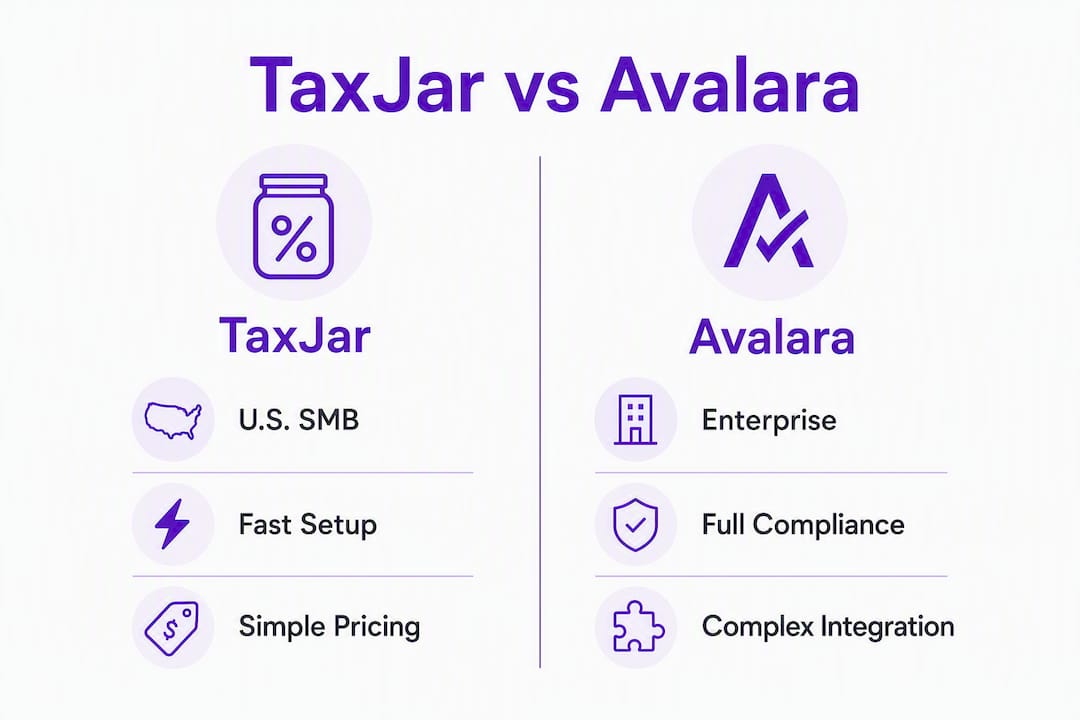
Two things stand out above everything else. First, TaxJar is genuinely fast to deploy and priced for simpler SMB scenarios, which is why DTC sellers on Shopify or Stripe reach for it first. Second, Avalara’s integration depth and compliance lifecycle coverage justify its higher cost only when your business actually needs those layers, as manual exemption management can become an audit liability as exemption customer counts grow large.
What TaxJar does well for U.S. small businesses
Stripe acquired TaxJar in 2021, and that context explains a lot about where the product excels. It was built for commerce-native workflows, and the Stripe acquisition deepened that positioning rather than broadening it into enterprise territory.

The core product is a sales tax calculation engine with AutoFile, a reporting dashboard, and a library of pre-built connectors for the platforms most SMBs actually use: Shopify, Amazon, WooCommerce, Etsy, BigCommerce, and Stripe itself. Setup on a standard Shopify store typically takes a few hours, not a few weeks. For a finance team of one or two people without an IT department, that matters enormously.
Where TaxJar wins:
- Fast time-to-live on modern commerce stacks
- Predictable subscription pricing with transparent tiers published on its pricing page
- AutoFile covers standard monthly, quarterly, and annual filing cadences across the states it supports
- Strong fit for sellers with simple channel mixes and no significant B2B exemption volume
- G2 users consistently rate it higher for ease of use and setup speed than Avalara
Known limitations:
- ERP connectors are limited; NetSuite and SAP integrations are not a native strength
- Exemption certificate management is basic: flagging only, no lifecycle tracking or renewal automation
- ZIP-code-based geolocation creates accuracy gaps in home-rule cities and special tax districts
- AutoFile does not cover prepayments, consolidated filings, or unusual state-specific calendars
Independent analysts position TaxJar as the right call for U.S.-focused brands under ~$5M with a simple channel mix. Past that revenue band, the limitations start compounding faster than the savings justify.
What Avalara (AvaTax) does well for enterprise compliance
Avalara is not just a tax calculator. It’s a full compliance lifecycle platform: AvaTax handles real-time calculation, Returns manages multi-state filing, CertCapture automates exemption certificate collection and renewal, and a separate module covers business license management. On top of that, it supports VAT and GST in roughly 190+ countries, which matters the moment you start selling internationally.

The integration story is where Avalara separates itself most clearly. Deep native connectors for NetSuite, SAP, Acumatica, Microsoft Dynamics, and Oracle mean that an ERP-dependent finance team doesn’t have to build or maintain custom middleware. For a $30M manufacturer with a NetSuite instance and hundreds of exempt B2B customers, that’s not a nice-to-have.
Where Avalara wins:
- ERP-native integrations that TaxJar simply doesn’t match
- CertCapture handles the full exemption certificate lifecycle: collection, validation, renewal reminders, and audit-ready storage
- Rooftop-level geocoding and larger product-code catalogs for accurate calculation in home-rule jurisdictions
- Audit-grade reporting and export formats that satisfy PE diligence teams
- Complex filing support: prepayments, consolidated returns, and state-specific calendar variations
The tradeoffs are real. Implementation typically runs weeks to months and often requires a certified Avalara partner or internal project management. Pricing is modular and quote-based, so the headline number rarely reflects total cost of ownership once you add Returns, CertCapture, and professional services. For companies preparing for an exit or PE diligence within 12–18 months, practitioners consistently recommend enterprise-grade audit-ready reporting and certificate management as standard expectations from diligence teams.
How do the two platforms compare on the details that matter?
Ease of setup and daily use
TaxJar wins here, and it’s not close. Finance teams without IT support get it live in hours on Shopify or Stripe. Avalara’s implementation timeline depends on your ERP and the complexity of your product catalog, but weeks is the floor and months is common for enterprise rollouts.
Integrations
TaxJar’s connector library is commerce-first: Shopify, Stripe, Amazon, WooCommerce, Etsy, BigCommerce. Avalara claims 1,400+ partner integrations, covering the full ERP and commerce spectrum. That number is marketing-forward; verify that the specific connector you need exists and works before signing. A demo integration test on your actual stack is worth more than any published count.
Pricing and total cost of ownership
TaxJar publishes transparent subscription tiers on its pricing page, structured for low-to-mid transaction volumes. Avalara’s pricing is modular and quote-based, and the total cost of ownership rises materially once you add Returns, CertCapture, and any partner implementation fees. For a rough scenario framing: a $3M DTC brand on Shopify will almost always find TaxJar cheaper and sufficient. An $8M brand with 15 nexus states and growing B2B volume is at the inflection point. A $25M company with an ERP and significant exempt sales will likely find Avalara’s TCO justified by audit risk reduction alone.
Filing automation and returns
TaxJar’s AutoFile covers standard monthly, quarterly, and annual cadences. It doesn’t handle prepayments, consolidated returns, or the unusual filing calendars some states require. Avalara’s Returns module covers those edge cases. If your business has a state with prepayment requirements or a non-standard calendar, TaxJar will leave you managing that manually.
Exemption certificate management
This is one of the clearest decision points. TaxJar flags exempt customers but doesn’t automate certificate collection, renewal reminders, or audit-trail documentation. Avalara’s CertCapture does all of that. The tipping point is roughly when your exempt customer count grows large enough that manual tracking becomes an audit liability rather than a spreadsheet task.
Reporting and audit readiness
Avalara produces audit-grade exports and documentation that satisfy M&A diligence teams. TaxJar’s reporting is solid for operational use but lighter on the structured evidence formats that PE firms and auditors expect.
API and developer features
Both platforms offer REST APIs. TaxJar’s is clean and well-documented for Shopify and Stripe stacks. Avalara’s API goes deeper on product-level tax codes, rooftop geocoding, and edge caching for high-volume enterprise workloads. For a headless commerce build or a custom middleware layer, Avalara’s API depth is a real advantage.
Support and onboarding
TaxJar offers self-serve documentation, email, and phone support, plus a 30-day free trial. Avalara provides enterprise CSM, professional services, and a partner ecosystem for implementation. The flip side: Avalara’s support model assumes you have a project to manage, not just a tool to turn on.
Pro Tip: Watch out for ZIP-code-only geolocation. If you sell into home-rule cities like Denver or Chicago, where tax rates vary at the address level rather than the ZIP code level, a ZIP-based calculation engine will produce errors that compound over time. Rooftop-level geocoding is the standard for audit-grade accuracy in those jurisdictions.
A concrete example: A $4M Shopify-native DTC brand selling apparel in 12 states, no B2B, no ERP, files standard cadences. TaxJar is the right call: fast setup, predictable cost, AutoFile handles the filing load. Now take that same brand at $12M after a PE investment, adding a wholesale channel with 200 exempt retailers across 18 states. The certificate volume alone tips the decision to Avalara.
How do you decide between TaxJar and Avalara?
Five questions will get you to the right answer faster than any feature matrix.
| Question | TaxJar | Avalara |
|---|---|---|
| Annual revenue modest? | Yes | No |
| ERP in use (NetSuite, SAP, Dynamics)? | No | Yes |
| Many active nexus states? | No | Yes |
| Significant B2B sales with exempt customers? | No | Yes |
| Preparing for exit or PE diligence soon? | No | Yes |
If you answered “Yes” to any of the Avalara column questions, that’s where you should be looking. If all your answers land in the TaxJar column, the simpler tool will serve you well and cost you less.
Contract and service-level questions to ask any vendor before signing:
- Does AutoFile/Returns cover every state where you currently have nexus, including any with prepayment requirements?
- Who owns the transaction data if you leave, and in what format can you export it?
- What’s the SLA for calculation API uptime, and what happens during an outage?
- Is your ERP connector certified and actively maintained, or community-built?
- What does onboarding actually cost, including any required partner engagement?
Red flags to watch for:
- Vendor can’t demonstrate a working integration with your specific ERP version
- AutoFile coverage list doesn’t include a state where you have significant volume
- Exemption certificate tooling is described as “coming soon” or requires a separate add-on purchase
- Implementation timeline estimate seems unusually short for your stack complexity
On TCO: subscription fees are the visible line item. Implementation partner fees, internal project time, and the cost of audit remediation if your tool lacks required coverage are the ones that surprise finance teams. For finance and accounting tool decisions generally, the hidden costs almost always exceed the headline price.
What should you expect if you switch platforms?
Migration is where buyers underestimate the work. Whether you’re moving from TaxJar to Avalara as you scale, or evaluating a switch in the other direction, the tasks are predictable even if the timeline isn’t.
Core migration tasks:
- Extract historical transaction data and map it to the new platform’s GL structure
- Reconcile historical returns: confirm filed amounts match the new system’s records before going live
- Clean up your exemption certificate backlog before migration, not after; importing a messy certificate file into CertCapture creates more work than starting clean
- Re-map product tax codes to the new platform’s taxonomy, especially if you have a large SKU catalog
- Run a parallel filing cycle: keep both systems active for one full filing period to catch discrepancies before you cut over
Who needs to be involved: Finance owns the project. IT or a developer handles the API/connector work. If you’re moving to Avalara from a simpler tool, budget for an Avalara-certified implementation partner, particularly if an ERP is in scope. External consultants are common and the cost is real.
Timeline expectations: TaxJar to Avalara migrations for mid-market companies typically run 6–12 weeks when an ERP is involved. Simpler moves (commerce-only, no ERP) can close in 2–4 weeks. Going the other direction (Avalara to TaxJar) is faster on the technical side but requires confirming that TaxJar’s coverage is sufficient for every state and filing cadence you currently use.
One sequencing note: If you’re migrating ahead of a fundraise or exit, clean your certificate records and reconcile historical returns before the diligence window opens. Auditors and PE teams expect registered-state counts, clean exemption certificate trails, and audit-ready exports as baseline documentation.
How Toolsplorer assessed TaxJar and Avalara
This comparison draws on vendor documentation, published pricing pages, G2 user review sentiment, third-party analyses from sources including TaxCloud and Eightx, and Avalara’s own vendor comparison materials. Where vendor claims are marketing-forward (particularly integration counts), that’s noted explicitly and the recommendation is to verify with a demo.
| Metric assessed | Source type | Notes |
|---|---|---|
| Ease of setup / G2 ratings | Third-party user reviews (G2) | Pattern-based; not a single score |
| Integration counts | Vendor documentation | Avalara: 1,400+ claimed; verify your connector |
| Filing coverage | Vendor docs + third-party analysis | AutoFile cadence limits confirmed via TaxCloud |
| Exemption certificate tooling | Vendor docs (CertCapture) | TaxJar: basic flagging only |
| Pricing transparency | Published pricing pages | TaxJar: transparent tiers; Avalara: quote-based |
| Geolocation accuracy | Vendor technical docs | Rooftop vs ZIP-code distinction sourced from Avalara |
| Audit/diligence readiness | Advisory and analyst sources | PE/exit context sourced from TaxCloud analysis |
Toolsplorer’s scoring methodology aggregates signals across user reviews, feature depth, pricing transparency, and integration breadth. Vendor-stated claims are flagged where independent verification wasn’t possible.
Key Takeaways
TaxJar is the right call for U.S.-focused ecommerce businesses under ~$5M with simple channel mixes; Avalara earns its higher cost for ERP-dependent, multi-state, or B2B-heavy operations where audit-grade compliance is non-negotiable.
| Point | Details |
|---|---|
| Revenue band decides the choice | TaxJar fits under ~$5M DTC; Avalara is generally recommended past $5–10M with ERP or heavy B2B volume. |
| Certificate volume is the tipping point | Once exempt customers grow large enough, CertCapture’s lifecycle management outweighs its cost. |
| TCO exceeds headline pricing | Avalara’s implementation, partner fees, and add-ons materially raise total cost beyond the subscription price. |
| Migration needs a clean starting point | Reconcile historical returns and certificate records before switching platforms, not after. |
| Toolsplorer comparison engine | Use Toolsplorer’s side-by-side tool reviews to validate vendor claims and shortlist the right fit for your stack. |
The part most buyers get wrong
The most common mistake in this decision isn’t picking the wrong tool. It’s picking the right tool for the company you are today and ignoring the company you’ll be in 18 months.
Finance teams at $4M DTC brands choose TaxJar because it’s fast and cheap, which is correct. Then they close a Series A, add a wholesale channel, and suddenly have 300 exempt B2B customers and a new CFO asking for audit-ready documentation. Migrating under that kind of time pressure, with a certificate backlog to clean and a diligence window approaching, is expensive and stressful in ways that a slightly higher subscription fee never would have been.
The reverse mistake is less common but real: a $6M brand that isn’t B2B-heavy and has no ERP buys Avalara because it sounds more serious, spends three months on implementation, pays for CertCapture they don’t need, and ends up with a tool that’s harder to use than what they had. Enterprise features don’t add value when your operational reality doesn’t require them.
The honest framing is this: treat sales tax as an operational admin task until your complexity says otherwise, then treat it as a strategic compliance risk and tool up accordingly. The threshold is usually somewhere between $5M and $10M, and it’s driven by B2B mix, nexus state count, and ERP presence more than revenue alone.
One practical recommendation: before you sign with either vendor, run an actual filing cycle in a demo environment with your real transaction data. A vendor who can’t support that test is telling you something important about what implementation will look like.
Toolsplorer helps you cut through the vendor noise
Choosing between TaxJar and Avalara is one decision. Knowing which finance and automation tools actually fit your stack, your budget, and your growth stage is an ongoing one.

Toolsplorer aggregates user reviews, feature data, and pricing signals across hundreds of SaaS tools so you can compare options without relying on vendor marketing alone. The scoring is AI-driven and pulls from multiple independent review sources, which means you get a data-backed shortlist rather than a sales pitch. For a decision like TaxJar vs Avalara, where the right answer depends on your specific revenue band and operational profile, that kind of structured comparison matters.
Run a side-by-side comparison on Toolsplorer and see how TaxJar, Avalara, and other tax compliance tools stack up against your actual requirements. Toolsplorer is an independent reviewer with no financial relationship with either vendor.
Useful sources
The sources below were used to build this comparison. Check each one directly for current pricing, filing coverage, and integration details, since vendor documentation changes and state-specific rules require confirmation with the vendor or a tax professional.
| Source | What it covers |
|---|---|
| TaxJar pricing page | Published subscription tiers, AutoFile credits, trial details |
| Avalara vs TaxJar (Avalara) | Vendor comparison, integration counts, CertCapture, geocoding claims |
| Avalara vs TaxJar (TaxCloud) | Independent scenario analysis, filing cadence coverage, SMB decision rules |
| G2 TaxJar vs Avalara | User review sentiment, ease-of-use ratings, setup speed patterns |
| Stripe newsroom: TaxJar acquisition | Acquisition context, commerce-native positioning |
| Eightx: Avalara vs TaxJar | Revenue-band decision framework, audit readiness, exit/PE context |
| PulseSignal: pricing comparison | Pricing structure, TCO framing, modular cost analysis |
Run your own trials where possible. For state-specific filing cadence confirmation, contact the vendor directly and ask them to demonstrate coverage for every state where you currently have nexus.
This article is general information, not tax or legal advice. Confirm current rules, filing requirements, and tool capabilities with a qualified tax professional or directly with the vendor.
FAQ
Who is Avalara’s biggest competitor?
TaxJar is Avalara’s most frequently cited direct competitor in the U.S. SMB and mid-market space, though Vertex is the primary alternative at the large-enterprise level.
What are the main competitors of TaxJar?
Avalara is TaxJar’s primary competitor. Other alternatives include Vertex (enterprise), TaxCloud (for certain merchant categories), and Stripe Tax for merchants already on the Stripe platform.
Who bought TaxJar?
Stripe acquired TaxJar in 2021, integrating it with Stripe Tax to strengthen commerce-native sales tax automation for merchants on the Stripe platform.
What happened to Avalara?
Avalara was taken private by Vista Equity Partners in 2022 after operating as a publicly traded company. It continues to operate as an independent compliance platform under that ownership.
TaxJar is generally the better fit for U.S.-focused small businesses under ~$5M in annual revenue using Shopify or Stripe, given its faster setup, transparent pricing, and lower total cost of ownership for standard filing needs.