

What’s the real difference between RingCX and RingEX?
RingCX is built for contact center teams. RingEX is built for everyone else. That single distinction drives every meaningful difference between the two platforms, and getting it wrong costs real money.
RingCX is RingCentral’s AI-powered contact center solution, purpose-built for dedicated support agents handling high volumes across multiple channels. RingEX is the company’s cloud-based unified communications platform, designed to give an entire workforce calling, messaging, video, and fax in one app. Most enterprises end up using both, deploying RingEX company-wide and adding RingCX specifically for their contact center teams.
The table below maps the core differences across the dimensions that matter most to enterprise buyers.
| Dimension | RingCX | RingEX | Best for |
|---|---|---|---|
| Primary focus | AI-powered contact center | Unified communications | CX teams vs. whole company |
| AI features | Virtual agents, real-time coaching, quality management | Basic IVR only | Advanced AI vs. standard |
| Digital channels | 20+ (voice, email, SMS, chat, social) | Voice, SMS, video, fax | Omnichannel vs. core channels |
| Starting price | $65/user/month | $30/user/month | Complex CX vs. general comms |
| Primary audience | Dedicated contact center agents | All employees | Specialists vs. generalists |
| G2 rating | 4.6/5 | 4.1/5 | — |
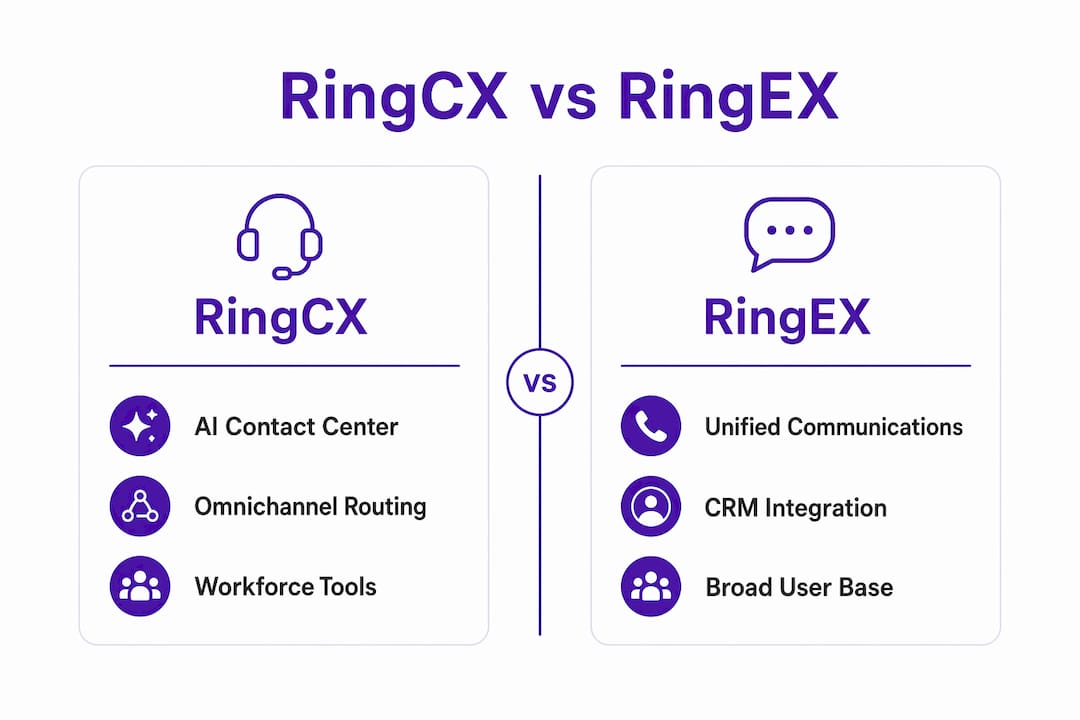
The price gap reflects genuine capability differences, not just branding. RingCX’s pricing covers AI coaching, omnichannel routing, workforce management, and analytics that RingEX simply does not include. RingEX covers the communication basics a typical employee actually needs.
Key decision factors:
- Choose RingCX if your team’s primary job is handling customer interactions at volume, across multiple channels, with AI-assisted quality management.
- Choose RingEX if you need a reliable, company-wide phone and collaboration system where customer support is a secondary function.
- Deploy both when your enterprise needs unified communications for the general workforce and a dedicated contact center layer for support agents.
How do users rate RingCX and RingEX?
User satisfaction splits clearly along use case lines. RingCX holds a 4.6 out of 5 on G2 from its contact center user base. RingEX carries a 4.1 out of 5 across more than 1,000 reviews on the same platform, and a 4.2 out of 5 on Capterra, reflecting a much broader and more varied audience.
RingEX users consistently praise how easy it is for non-technical employees to pick up. Reviewers on Gartner Peer Insights note that end users find the calling and messaging experience straightforward, while admins flag the back-end configuration as genuinely complex. One recurring theme: the admin interface is not intuitive at first, and RingCentral’s onboarding support has drawn criticism for inconsistency.
RingCX feedback tells a different story. AI coaching and supervision tools generate strong results for agent productivity, but they also create cultural friction. Some contact center managers report that agents feel micromanaged when AI monitors every conversation and surfaces real-time feedback. That tension is worth planning for before deployment, not after.
- RingEX strengths cited by users: cross-platform access, CRM integration, fax reliability, and call queue management.
- RingEX friction points: analytics inconsistencies, holiday routing limitations, and support responsiveness.
- RingCX strengths: AI-driven performance visibility, omnichannel routing, and agent coaching at scale.
- RingCX friction: learning curve for supervisors managing AI workflows, and cultural adjustment to AI monitoring.
Pro Tip: Before rolling out RingCX’s AI quality management, brief your contact center supervisors on how the scoring works. Agents who understand the system’s logic accept it far better than those who encounter it without context.
What features separate RingCX from RingEX?
The feature gap between these two platforms is wider than most buyers expect. RingEX covers the communication fundamentals: unlimited domestic calling, SMS and MMS, video meetings, basic IVR, and online fax. That set handles the daily needs of a typical employee well. What it does not do is manage agent queues, route contacts across digital channels, or apply AI to live conversations.

RingCX is where the AI capabilities live. The platform includes virtual agents, real-time agent assistance, AI quality management, and integrations across 20+ digital channels as standard features in a single license. Real-time assistance means an agent gets suggested answers and relevant knowledge surfaced during a live call, not after it ends. AI quality management scores every interaction automatically, which gives supervisors a complete picture of team performance without manual call sampling.
| Feature | RingCX | RingEX |
|---|---|---|
| Omnichannel routing | Yes (20+ channels) | No |
| AI virtual agents | Yes | No |
| Real-time agent assist | Yes | No |
| AI quality management | Yes | No |
| Workforce management | Yes | No |
| Unlimited domestic calling | Yes | Yes |
| Video meetings | Via RingEX integration | Yes |
| SMS/MMS | Yes | Yes |
| Basic IVR | Yes | Yes |
| Online fax | No | Yes |
RingCX also includes workforce management tools: demand forecasting, scheduling optimization, and performance tracking. For a contact center running dozens of agents across shifts, that capability alone justifies the price difference over RingEX. RingEX has no equivalent.
What integrations and platforms do RingCX and RingEX support?
Both platforms run as cloud-based, SaaS-delivered solutions accessible via web browser, desktop app, and mobile on iOS and Android. That cross-platform reach is one of RingEX’s most cited advantages in user reviews, particularly for distributed teams where employees switch between devices throughout the day.

RingCX and RingEX are fully integrated with each other, which matters operationally. When a conversation moves from a RingCX contact center interaction to a RingEX internal call, supervisors get complete visibility across both. Agents and employees work within the same RingCentral app, so there is no context switching between separate tools.
On third-party integrations, RingEX connects well with CRM platforms, which users frequently highlight as a deciding factor. Reviewers on Gartner Peer Insights specifically mention CRM integration as a meaningful productivity driver. RingCX extends that further with omnichannel CRM integrations designed for contact center workflows, including data passed between customer interactions and agent records in real time.
RingCX’s 20+ digital channel integrations cover voice, email, SMS, live chat, and social messaging. For enterprises evaluating RingCX alternatives in the contact center space, that channel breadth is a genuine differentiator. Number porting between RingEX and RingCX requires planning, and enterprises should expect some complexity in the initial configuration, particularly when migrating existing business telephone numbers.
What support, training, and pricing should you expect?
RingCentral offers phone support for RingEX, along with online documentation and self-service resources. User feedback on support quality is mixed: routine issues get resolved, but complex configuration problems and intermittent faults have drawn criticism for slow resolution and repeated information requests from support teams.
Training options for both platforms include online documentation, video tutorials, and admin guides. RingEX users on Gartner Peer Insights note that RingCentral did not always deliver the admin training originally promised during onboarding, though most teams were able to work through configuration independently. RingCX, given its technical depth, requires more structured onboarding, and RingCentral recommends partner-assisted deployment for enterprises migrating complex environments.
On pricing, RingEX starts at $30 per user per month and offers three published plan tiers. RingCX starts at $65 per user per month. RingEX offers a free trial; RingCX does not list trial information publicly, but demos are available through RingCentral’s sales team. Both platforms are sold on a per-user, per-month subscription basis.
How should you deploy RingCX and RingEX in your organization?
The most practical deployment model for mid-to-large enterprises is a split architecture: RingEX for the general workforce, RingCX for the contact center department. This approach gives every employee a capable communications platform while giving support agents the AI-driven tools their role actually demands.
Organizations that fit RingEX alone are typically those where customer interactions are handled by general employees rather than a dedicated support team. A professional services firm where account managers take client calls, for example, rarely needs omnichannel routing or AI quality scoring. RingEX covers that scenario at roughly half the per-user cost.
RingCX becomes the right choice when the contact center is a distinct operational unit with dedicated agents, defined queues, performance targets, and a need for real-time supervision. The technical complexity of RingCX means admins should plan for a meaningful learning curve in managing call routing and automated workflows. Partner-assisted implementation is worth considering for organizations without in-house telephony expertise.
A practical selection checklist:
- Do you have dedicated contact center agents whose primary job is handling customer interactions? If yes, RingCX.
- Is customer support a secondary function for employees with other responsibilities? If yes, RingEX or the RingEX Customer Engagement Bundle.
- Do you need AI-driven coaching, quality scoring, and workforce management? RingCX only.
- Is your priority cross-platform calling, messaging, and video for a distributed workforce? RingEX.
- Are you running both a general workforce and a contact center? Deploy both and use the native integration.
Pro Tip: Phase the RingCX rollout by starting with one contact center team before expanding. Early adopters surface configuration issues and build internal expertise that makes the broader deployment faster and less disruptive.
Toolsplorer helps you compare communication platforms without the sales pitch
Choosing between RingCX, RingEX, and the broader field of communication tools takes more than reading vendor documentation. Toolsplorer aggregates verified reviews, feature lists, and current pricing across hundreds of business software categories, so you can compare options on substance rather than marketing copy.
If you want to go deeper on AI-driven platforms similar to RingCX, Toolsplorer’s AI tools reviews cover the contact center and automation space with the same data-backed approach. For a broader look at what the market offers beyond RingCentral, Toolsplorer’s full software directory gives you unbiased comparisons across every major category, with no vendor bias built into the rankings.
Key Takeaways
RingCX suits dedicated contact center teams needing AI-driven omnichannel tools, while RingEX covers company-wide unified communications at roughly half the per-user cost.
| Point | Details |
|---|---|
| Core use case split | RingCX is for contact center agents; RingEX is for general workforce communications. |
| Pricing difference | RingCX starts at $65/user/month; RingEX starts at $30/user/month. |
| AI capabilities | RingCX includes virtual agents, real-time coaching, and quality management; RingEX offers basic IVR only. |
| Best deployment model | Most enterprises deploy RingEX company-wide and add RingCX for their contact center department. |
| Toolsplorer | Use Toolsplorer to compare RingCX, RingEX, and alternatives with aggregated, unbiased reviews and current pricing data. |
FAQ
What is RingCX?
RingCX is RingCentral’s AI-powered contact center platform, built for dedicated support teams handling high-volume, omnichannel customer interactions. It includes virtual agents, real-time agent assistance, AI quality management, and integrations across 20+ digital channels, all in a single license starting at $65 per user per month.
What is RingCentral RingEX?
RingCentral RingEX is a cloud-based unified communications platform that combines voice calling, SMS, video meetings, and fax in one app for company-wide use. It starts at $30 per user per month and is designed for general employees rather than dedicated contact center agents.
What did RingCentral used to be called?
RingCentral’s unified communications product was previously marketed as RingCentral MVP (Message, Video, Phone) before being rebranded as RingEX.
Who are RingCentral’s biggest competitors?
RingCentral’s main competitors in unified communications include Microsoft Teams, Zoom Phone, and Webex. In the contact center space, RingCX competes with platforms like Genesys Cloud CX and Five9.
Can RingCX and RingEX work together?
Yes. RingCX and RingEX are fully integrated within the RingCentral app, giving supervisors visibility when conversations move between the contact center and the broader organization. Many enterprises deploy both platforms simultaneously for this reason.