

TL;DR:
- For merchants processing over $10,000 monthly, interchange-plus providers like Authorize.Net and Adyen offer cost-effective options, while flat-rate models suit lower volumes. Switching payment infrastructure involves risks, so prioritizing stability and migration support is essential. Choosing the best provider depends on your volume, international sales, and support needs, not just rates.
If you process under $10,000 a month, Stripe is probably fine. Push past that, and the math starts working against you. Here are the fastest answers by use case:
- Cheapest at scale: Authorize.Net with an interchange-plus merchant account
- Best POS + retail: Square for zero monthly fees and built-in hardware
- Best SaaS merchant-of-record: Paddle or FastSpring to offload tax and compliance entirely
- Best for high-risk merchants: PaymentCloud, which specializes in alternative underwriting
- Best for recurring bank debits/ACH: GoCardless, built specifically for bank-initiated collections
| Use case | Best pick | Pricing model |
|---|---|---|
| Low-cost at scale | Authorize.Net | Interchange-plus + monthly fee |
| POS + online retail | Square | Flat-rate, no monthly fee |
| SaaS / digital goods MoR | Paddle or FastSpring | Revenue share |
| High-risk merchants | PaymentCloud | Custom / negotiated |
| Recurring ACH/bank debits | GoCardless | Per-transaction flat |
One caveat before you shortlist: switching payment infrastructure carries real risk. Downtime, failed reconciliation, and data migration errors can cost more than a year of fee savings. Prioritize platform stability and migration support over chasing the lowest headline rate.
Table of Contents
- What are the best Stripe alternatives right now?
- Top picks: what each provider actually does well
- How do you choose the right payment processor?
- When does flat-rate pricing beat interchange-plus?
- Key Takeaways
- The real reason most merchants pick the wrong processor
- Toolsplorer cuts your shortlist from 20 providers to 3
- Useful sources and further reading
- FAQ
What are the best Stripe alternatives right now?
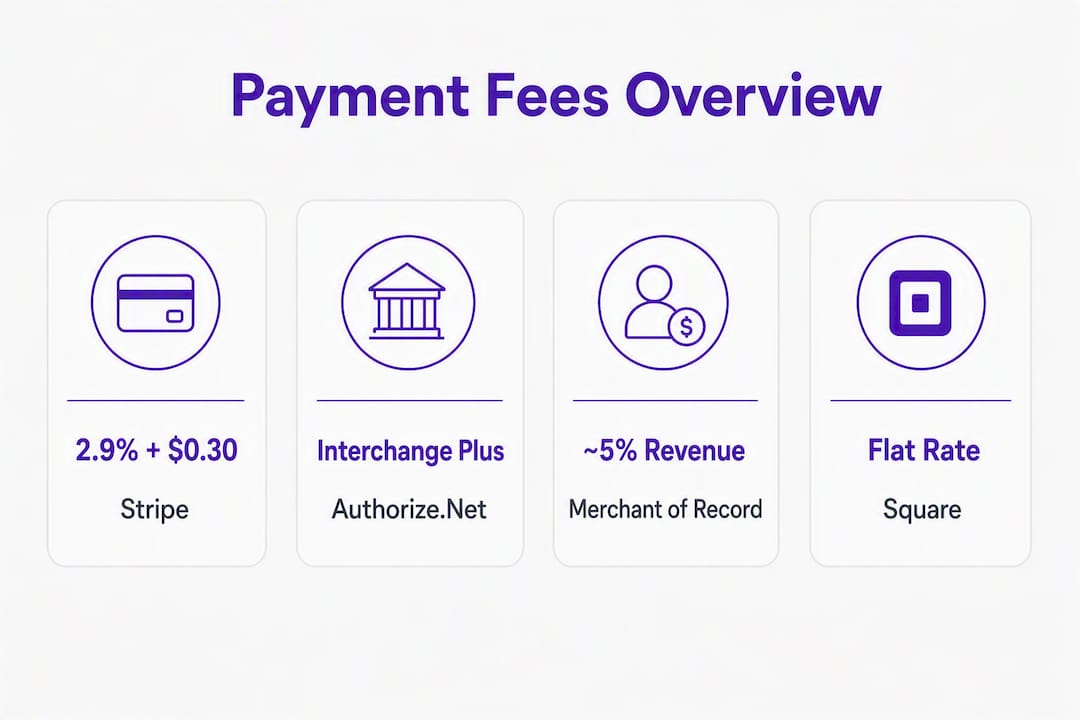
The table below covers all 20 providers across the dimensions that actually affect your decision. Pricing reflects publicly listed rates as of 2026; always confirm with each vendor before signing.
| Provider | Best for | Pricing model & headline fees | Recurring/subscriptions | Developer/API | Payment methods | Global reach | Payout timing | Support level | Fraud/dispute tools |
|---|---|---|---|---|---|---|---|---|---|
| Square | Small retail + omnichannel | Flat-rate pricing for in-person and online transactions | Basic recurring invoices | Good (REST APIs) | Cards, ACH, wallets | US-focused | Next business day | Phone + email | Chargeback protection add-on |
| PayPal | Consumer trust + invoicing | Standard checkout percentage plus a fixed fee per transaction | PayPal Subscriptions | Moderate | Cards, PayPal wallet, Venmo, BNPL | 200+ countries | 1–3 days | Phone + chat | Seller Protection program |
| Braintree | Deep checkout customization | Percentage plus fixed fee for cards; no fees for PayPal transactions | Braintree Recurring Billing | Excellent (REST + GraphQL) | Cards, PayPal, Venmo, ACH | 45+ countries | 2 days | Email/developer docs | Advanced Fraud Tools (Kount) |
| Adyen | Enterprise omnichannel | Interchange + $0.11–$0.13 processing fee | Adyen Subscription | Excellent | Cards, wallets, local methods | 40+ currencies | Daily/weekly | Dedicated account manager | RevenueProtect |
| GoCardless | Recurring ACH/bank debits | A capped percentage fee per transaction | Native recurring | Moderate (REST API) | ACH, SEPA, BECS | 30+ countries | 2–3 days | Email + chat | Dispute resolution tools |
| Chargebee | SaaS subscription billing | From $599/mo (billing platform only; needs gateway) | Full dunning + metered billing | Excellent | Depends on gateway | Via gateway | Via gateway | Email + phone | Via gateway |
| Authorize.Net | Interchange-plus gateway | A monthly fee plus per transaction fees plus interchange costs | Basic ARB | Good | Cards, ACH, e-checks | US-primary | 2 days | 24/7 phone | Advanced Fraud Detection Suite |
| Paddle | SaaS MoR | A percentage plus fixed fee per transaction | Full subscription management | Good (REST API) | Cards, PayPal, local methods | 200+ countries | Weekly | Email + account manager | Paddle handles disputes |
| 2Checkout (Verifone) | Global digital goods | A percentage plus fixed fee per transaction | Subscription + dunning | Good | Cards, PayPal, local methods | 180+ countries | Weekly | Email + phone | Fraud scoring |
| FastSpring | SaaS/software MoR | Revenue share model with variable rates | Full subscription + tax | Moderate | Cards, PayPal, wire | 200+ countries | Monthly/weekly | Email + account manager | Built-in fraud review |
| Checkout.com | Mid-market/enterprise APIs | Interchange + markup (custom) | Subscription APIs | Excellent | Cards, wallets, local methods | 150+ currencies | Daily | Dedicated support | Risk management suite |
| Lemon Squeezy | Indie SaaS + digital creators | A percentage plus fixed fee per transaction | Built-in subscriptions | Moderate | Cards, PayPal | 130+ countries | Weekly | Basic fraud tools | |
| Payoneer | Cross-border payouts | A receiving fee that varies by amount | Not primary focus | Moderate | Bank transfers, cards | 190+ countries | 2–5 days | Phone + email | Basic |
| PayPro Global | International digital goods | Custom (MoR model) | Subscription + tax | Moderate | Cards, PayPal, local | 180+ countries | Monthly | Email + phone | Fraud screening |
| Mollie | European payment methods | A fixed fee plus interchange for EU cards | Mollie Subscriptions | Good | Cards, iDEAL, Klarna, SEPA | EU-focused | Next day (EU) | Email + phone | Basic fraud tools |
| Sensapay | Cross-border acquiring | Custom / negotiated | Limited | Moderate | Cards, local methods | Multi-region | Custom | Basic | |
| PaymentCloud | High-risk merchants | Custom (negotiated) | Basic recurring | Moderate | Cards, ACH, e-checks | US-primary | 2–3 days | Dedicated agent | Chargeback monitoring |
| ConnectPay | Embedded platform payments | Custom | Platform payouts | Good (APIs) | Cards, bank transfers | EU/US | Custom | Basic | |
| Wise (Business) | Low-cost FX + multi-currency | 0.41%–2.85% conversion fee | Not primary focus | Good (API) | Bank transfers, debit | 160+ countries | 1–2 days | Email + chat | Basic |
| Payoneer (cross-border) | Marketplace payouts | See above | See above | See above | See above | See above | See above | See above | See above |
Pro Tip: Interchange-plus pricing (Authorize.Net, Adyen, Checkout.com) typically saves 10–20% versus flat-rate models at high volume because the processor isn’t bundling average risk into a single premium. Flat-rate wins at low volume because the predictability is worth the small premium.
A few quick notes on the providers that need context beyond the table:
- Chargebee is a billing layer, not a payment processor. You still need a gateway underneath it (Stripe, Braintree, Adyen). Its value is in dunning logic, metered billing, and revenue recognition.
- Mollie is priced in euros and optimized for EU merchants. US merchants can use it for European storefronts, but it’s not a primary US acquiring solution.
- ConnectPay and Sensapay publish limited public pricing; both require a direct sales conversation.
- Wise (Business) is not a payment gateway. It’s a multi-currency holding account. Pair it with a gateway for checkout; use it to hold and convert international receivables cheaply.
Top picks: what each provider actually does well
Low-cost at scale: Authorize.Net and Adyen
Authorize.Net is the oldest name on this list and still one of the most practical for merchants who want to separate the gateway from the acquiring relationship. You pay $25 a month plus $0.10 per transaction, then negotiate interchange-plus rates with your merchant account provider separately. That structure lets you shop acquiring costs independently, which is where the real savings come from at volume. The Advanced Fraud Detection Suite is included, and 24/7 phone support is standard.

Adyen takes a similar interchange-plus approach but bundles global acquiring, omnichannel POS, and enterprise-grade routing into one platform. The minimum monthly invoice requirement makes it unsuitable for small merchants, but for mid-market and enterprise players it’s one of the few providers that genuinely handles in-store and online under one contract.
All-in-one POS: Square
Square is the right answer for any merchant who sells in person and online and doesn’t want to manage two separate systems. No monthly fee, free card reader, and a flat A flat-rate percentage plus fixed fee for in-person transactions. The trade-off is that flat-rate pricing gets expensive fast at high volume, and Square’s developer APIs, while functional, aren’t as deep as Stripe’s. For a retailer doing under $250,000 a year, the simplicity is worth more than the fee difference.
Merchant-of-record for SaaS: Paddle and FastSpring
Paddle charges a percentage plus fixed fee per transaction and takes on the legal seller-of-record role, meaning it files taxes in every market you sell into. FastSpring operates similarly with a custom revenue-share model, typically in the revenue share percentage in the mid single digits range, and adds full subscription management and a self-serve customer portal. Both are frequently recommended for SaaS vendors who want to offload compliance entirely rather than build tax infrastructure themselves.
The cost is real: a revenue share percentage in the mid single digits is materially higher than Stripe’s 2.9% + $0.30. The question is whether your tax and compliance overhead (accountants, software, legal review) costs more than the MoR premium. For most early-stage SaaS companies selling internationally, it does.
High-risk merchants: PaymentCloud
PaymentCloud specializes in merchant categories that standard PSPs decline: firearms, nutraceuticals, CBD, adult content, travel, and subscription boxes with high chargeback rates. It offers dedicated account managers, chargeback monitoring, and custom underwriting. Pricing is negotiated rather than published. If you’ve been declined by Stripe or Square, PaymentCloud is the first call to make. For a deeper look at how high-risk underwriting works in practice, Toolsplorer’s review of Payment Nerds covers the category well.
Recurring bank debits: GoCardless
GoCardless built its entire product around bank-initiated payments: ACH in the US, SEPA in Europe, BECS in Australia. Rates run 0.5%–1% per transaction with a cap, which is significantly cheaper than card processing for subscription businesses with predictable billing cycles. The API is clean, and the recurring billing logic is native rather than bolted on. The limitation is obvious: customers who prefer to pay by card need a different solution alongside it.

Global routing and cross-border: Checkout.com and Braintree
Checkout.com is built for merchants who need modern APIs and global acquiring without the enterprise-only minimums of Adyen. Its intelligent payment routing and local acquiring network can increase authorization rates for cross-border transactions, which matters when you’re selling into markets where a US-issued card gets declined at higher rates. Braintree covers similar ground with the added advantage of native PayPal and Venmo integration, which is a genuine conversion lift for US consumer checkouts.
Digital creators and indie SaaS: Lemon Squeezy
Lemon Squeezy is the simplest MoR option for solo developers and small digital product sellers. At A revenue share model with percentage plus fixed fee, it’s priced identically to Paddle but with a simpler onboarding process and built-in product delivery. It handles subscriptions, license keys, and file delivery in one dashboard. The trade-off is limited customization and fewer supported payment methods than Paddle.
Cross-border payouts: Payoneer and Wise (Business)
Payoneer and Wise serve different needs that are often confused. Payoneer is built for marketplace payouts and freelancer receivables: you get a multi-currency account number that marketplaces like Amazon, Upwork, and Fiverr pay into directly. Wise (Business) is better for businesses that hold and convert multi-currency balances, with FX margins starting around 0.41%. Neither replaces a payment gateway for checkout; both replace expensive wire transfers for moving money internationally.
Pro Tip: For global expansion, evaluate whether a provider offers local acquiring and intelligent routing rather than assuming a single global account will perform equally in every market. A 3–6% improvement in authorization rates on cross-border cards compounds quickly at volume.
How do you choose the right payment processor?
Start with these questions before you talk to any sales team:
- What’s your monthly processing volume? Under $10K: flat-rate is fine. Over $50K: run the interchange-plus math.
- Do you sell subscriptions? If yes, does the provider have native dunning, or do you need a billing layer like Chargebee on top?
- Do you sell internationally? If yes, do you need a MoR (Paddle, FastSpring) or just multi-currency acquiring (Checkout.com, Adyen)?
- What’s your chargeback rate? Above 1%, you need a high-risk specialist or you’ll lose your account.
- Do you sell in person? If yes, Square or Adyen are the only providers with serious integrated POS.
- How technical is your team? Stripe and Braintree require developer resources. Square and PayPal do not.
Questions to ask during sales calls
- What is your reserve policy, and under what conditions do you hold funds?
- How do you handle chargebacks, and what’s your dispute resolution SLA?
- Do you offer a sandbox environment for pre-launch testing?
- What migration assistance do you provide for data export and API cutover?
- What’s on your API roadmap for the next 12 months?
Red flags to watch for
- Opaque interchange fees with no itemized statement
- Underwriting delays longer than 5 business days with no status updates
- No dunning tools or retry logic for failed subscription payments
- No local acquiring for your primary international markets
- Support that’s email-only with no SLA commitment
Migration timeline from Stripe
Switching payment infrastructure is high-risk. A realistic timeline for a typical online merchant:
- Weeks 1–2: Export Stripe data (customers, subscriptions, payment methods). Note: raw card data cannot be exported from Stripe; you’ll need to use Stripe’s card migration service or ask your new provider about tokenization transfer.
- Weeks 3–4: Set up new account, complete underwriting, configure sandbox environment.
- Weeks 5–6: Integrate new API, test all checkout flows, test subscription creation and cancellation.
- Week 7: Soft launch with a small percentage of traffic. Monitor decline rates and error logs.
- Week 8: Full cutover. Update DNS/checkout endpoints. Notify customers if billing details change.
- Weeks 9–10: Reconcile first full billing cycle. Confirm payout timing and reserve policy in practice.
Total estimated calendar time: Approximately two to three months for migration time for a merchant with moderate technical resources. Simpler setups (no subscriptions, no custom checkout) can move faster; complex subscription migrations with large customer bases can take 16+ weeks.
Pre-launch checklist before going live:
- Test card authorization, capture, and refund flows
- Test subscription creation, upgrade, downgrade, and cancellation
- Confirm webhook delivery and retry logic
- Verify payout schedule matches your cash flow needs
- Test chargeback notification flow end-to-end
- Confirm tax calculation (especially if switching from a MoR)
When does flat-rate pricing beat interchange-plus?
The answer is almost always about volume. Here’s the math.
Pricing model definitions:
- Flat-rate: One fixed percentage + fixed fee per transaction (Stripe: 2.9% + $0.30). Simple, predictable, no monthly fee.
- Interchange-plus: Actual card network cost + a transparent processor markup (e.g., interchange + 0.25% + $0.10). Lower at scale, but requires a monthly gateway fee.
- Revenue-share MoR: Provider takes a percentage of gross revenue (A revenue share percentage in the mid single digits) and handles tax, compliance, and disputes.
- Tiered pricing: Transactions bucketed into “qualified,” “mid-qualified,” and “non-qualified” tiers. Generally the least transparent model; avoid it.
Sample cost calculations for three merchant profiles:
| Merchant profile | Monthly volume | Stripe flat-rate cost | Interchange-plus cost | MoR cost (5%) |
|---|---|---|---|---|
| Low volume, high ticket ($500 avg) | $5,000 (10 txns) | $148 (2.9% + $3.00) | ~$155 (interchange avg ~2.5% + $25 gateway) | $250 |
| Mid-volume, subscriptions ($50 avg) | $25,000 (500 txns) | $775 | ~$650 (interchange avg ~1.8% + $25 + $50 txn fees) | $1,250 |
| High-volume, low margin ($30 avg) | $100,000 (3,333 txns) | $3,233 | ~$2,358 (interchange avg ~1.9% + $25 + $333 txn fees) | $5,000 |
At moderate subscription volumes, interchange-plus can provide meaningful monthly savings, or $1,500 a year. At higher subscription volumes, the cost gap increases substantially. Industry practitioners report that interchange-plus pricing can save a significant percentage at high volume versus flat-rate processing.
The MoR column shows why Paddle and FastSpring are only worth it when tax and compliance savings justify the premium. For a US-only SaaS with no international sales, a MoR is almost always the wrong choice on cost alone.
Hidden costs to factor into total cost of ownership:
- Monthly gateway fees vary by provider
- Rolling reserves may be required for certain accounts
- Chargeback fees apply per dispute
- Foreign exchange margins vary by provider
- Payout timing can impact cash flow significantly
Break-even rule of thumb: Interchange-plus becomes cheaper than Stripe’s flat-rate at roughly $20,000–$30,000 in monthly processing volume for most merchant categories, assuming a $25/month gateway fee and average interchange rates. Run your own numbers using Toolsplorer’s pricing comparison methodology as a framework.
Key Takeaways
Choosing the right Stripe alternative comes down to three variables: your monthly volume, whether you need a merchant-of-record, and how much human support matters to your team.
| Point | Details |
|---|---|
| Volume drives pricing model | Interchange-plus typically beats flat-rate above $20,000–$30,000 in monthly processing volume; below that, flat-rate simplicity wins. |
| MoR is worth the premium for international SaaS | Paddle and FastSpring charge 5%+ but handle tax remittance across every market, which saves more than the fee difference for most global sellers. |
| Migration takes Approximately two to three months for migration time minimum | Card data can’t be exported raw from Stripe; plan for tokenization transfer and a soft-launch period before full cutover. |
| Support quality drives switching decisions | Merchant frustration with limited human support is one of the most common reasons businesses leave developer-first processors. |
| Toolsplorer for faster shortlisting | Toolsplorer’s AI-driven scoring aggregates reviews across providers so you can build a shortlist in minutes rather than weeks. |
The real reason most merchants pick the wrong processor
The conventional wisdom says to compare headline rates and pick the lowest number. That’s the wrong frame.
The merchants who end up unhappy with their payment processor almost always made the decision on fee math alone and ignored two things: support responsiveness and the actual cost of a failed migration. A processor that saves you $200 a month but takes 72 hours to respond when your checkout breaks on Black Friday is a bad trade. A MoR that charges 5% but files VAT in 40 countries is genuinely cheaper than hiring a tax consultant to do it manually.
The other thing most comparison articles miss: Stripe’s flat-rate model is specifically designed to be easy to understand, not cheap to use. It’s a developer-first product that assumes you’ll outgrow it. The question isn’t whether Stripe is good. It’s whether you’ve outgrown the use case it was built for.
For most merchants reading this, the right answer is to shortlist two providers: one interchange-plus option for cost efficiency at scale, and one MoR or POS option depending on whether you sell software internationally or in person. Then run a 30-day sandbox test on both before committing. The fee math matters, but the integration experience and support quality during that test will tell you more than any rate card.
Toolsplorer cuts your shortlist from 20 providers to 3
Evaluating 20 payment processors side by side takes weeks. Toolsplorer’s AI-driven scoring system aggregates verified reviews from multiple sources, weights them against your specific use case (volume, subscription complexity, risk profile, global reach), and produces a ranked shortlist you can act on immediately.
Every provider in this article has a full profile in Toolsplorer’s tool directory, including current pricing, feature breakdowns, and user review summaries. You can filter by pricing model, supported payment methods, and API quality in under two minutes. If you want to understand exactly how Toolsplorer scores and ranks software, the methodology page walks through the full process. Start your shortlist now and skip the 10-tab research session.
Useful sources and further reading
These sources were selected for authority, recency, and direct relevance to payment processor evaluation. Always verify current pricing with each vendor’s official documentation before signing, and test with sandbox integrations before going live.
- Best Stripe Alternatives Of 2025 — Forbes Advisor: Broad roundup covering pricing models, POS options, and use-case recommendations.
- Stripe alternatives — Paddle: Paddle’s own comparison, useful for understanding MoR trade-offs and migration risk framing.
- Top 5 Stripe Alternatives — GoCardless Guides: GoCardless’s comparison focused on bank debit and recurring payment use cases.
FAQ
What is Stripe most comparable to?
Stripe is most comparable to Braintree and Checkout.com: all three are developer-first payment platforms with strong APIs, card processing, and subscription support. Braintree adds native PayPal integration; Checkout.com focuses more on enterprise global acquiring.
Is Adyen or Stripe better for my business?
Stripe is better for small to mid-size merchants who need quick setup and flat-rate simplicity. Adyen is better for enterprise merchants who need global acquiring, omnichannel POS, and interchange-plus pricing at high volume, though it requires a minimum monthly processing commitment.
Which payment gateway is best for small businesses in the US?
Square is the most practical choice for US small businesses that sell in person and online, with no monthly fee and built-in POS hardware. For online-only small businesses, Stripe or PayPal remain the easiest starting points before volume justifies switching.
Is Shopify Payments just Stripe?
Shopify Payments is powered by Stripe’s infrastructure but is a separate product with its own pricing (starting at 2.9% + $0.30 on the Basic plan) and Shopify-specific features. You cannot use Shopify Payments outside of Shopify, and switching away from it within Shopify adds a third-party transaction fee.
When does switching from Stripe actually save money?
Switching to an interchange-plus provider typically saves money once you exceed roughly $20,000–$30,000 in monthly processing volume. Below that threshold, the monthly gateway fee and setup effort usually offset the per-transaction savings.