

Restaurant365 leads the multi-unit restaurant accounting and back-office market, but it starts at $469 per month and typically takes 2–6 months to implement. That combination of cost and complexity pushes a lot of operators to look elsewhere. The good news: the alternatives are better than ever, and many deliver faster time to value by focusing on one operational layer rather than trying to do everything, as explored in these best facility management software alternatives.
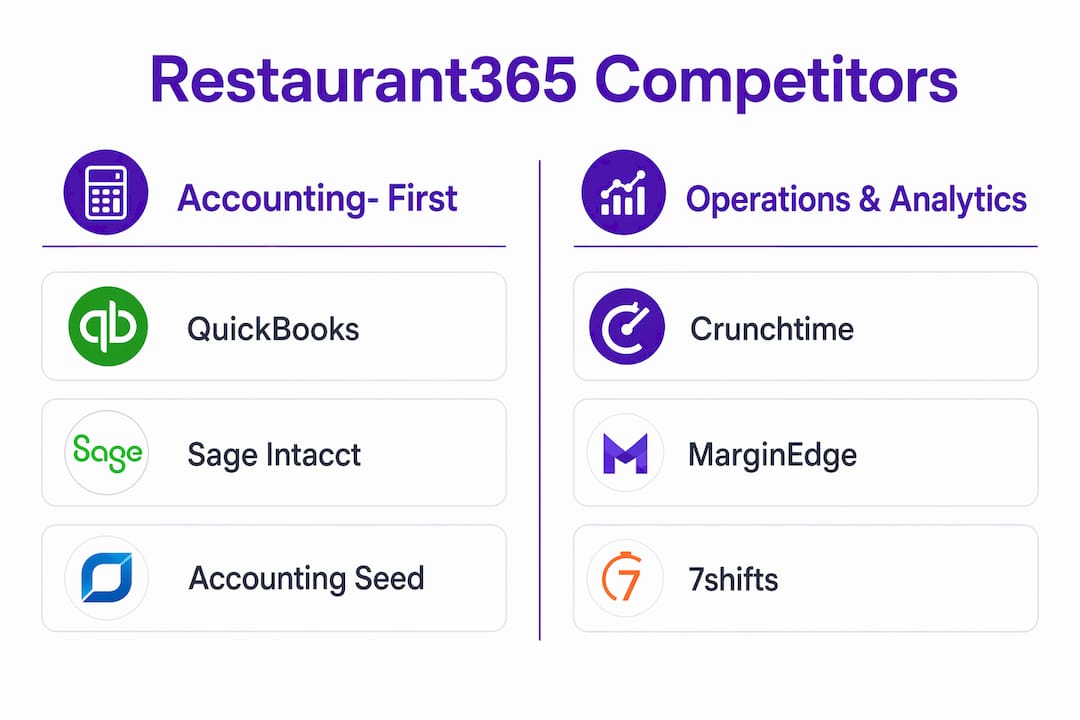
The main Restaurant365 competitors break down into five categories:
- Accounting-first: QuickBooks Online (from $30/month), Xero, Sage Intacct, QuickBooks Online Advanced, QuickBooks Enterprise, NetSuite, Workday Financial Management, Odoo, Sage 50 Accounting, and Accounting Seed. Best for operators who want clean financials without a full ERP.
- Inventory and purchasing: MarketMan ($179–$249/month), Genius, and Plate IQ. Best for food-cost-heavy operations where purchasing discipline drives margin.
- Invoice automation: MarginEdge ($350/location/month) and Plate IQ. Best as an overlay on top of existing accounting tools rather than a full replacement.
- Workforce and scheduling: 7shifts, HotSchedules, Connecteam, Homebase, Schedulefly, and Deputy. Best for restaurants where labor cost control is the primary pain point.
- Operations and AI: Crunchtime, Aedan Rose, Restroworks, Restroworks Restaurant POS, opsi, Xenia, and Garde. Best for multi-unit groups needing analytics, compliance, or AI-powered guest engagement.
No single alternative matches Restaurant365’s all-in-one depth. What most operators find instead is that a modular stack built from two or three specialized tools covers their actual needs faster and at lower total cost.
Who are the top Restaurant365 competitors in 2026?
The 27 alternatives below cover every major operational category. Pricing, core features, ease of use, and target business size vary widely, so the table gives you the comparison at a glance before the deeper profiles.
| Product | Best For | Pricing | Core Features | Ease of Use | Target Size |
|---|---|---|---|---|---|
| Sage Intacct | Multi-entity enterprise accounting | Custom | Financial consolidation, compliance, reporting | Moderate | Multi-unit enterprise |
| Xero | Small to mid-sized restaurant accounting | — | Cloud accounting, app integrations, invoicing | High | Small to mid |
| Accounting Seed | Salesforce-native custom workflows | Custom | CRM integration, custom accounting | Moderate | Mid to enterprise |
| 7shifts | Restaurant labor scheduling | — | Scheduling, labor compliance, team communication | High | Small to multi-unit |
| MarketMan | Inventory and purchasing control | $179–$249/mo | Inventory tracking, ordering, waste management | Moderate | Small to mid |
| QuickBooks Online | Affordable small restaurant accounting | From $30/mo | Accounting, payroll add-ons, integrations | High | Small |
| Crunchtime | Multi-unit analytics and food cost | Custom | Ops analytics, food cost, labor reporting | Moderate | Multi-unit enterprise |
| MarginEdge | Invoice processing and prime cost | $350/location/mo | Invoice automation, real-time P&L, integrations | High | Small to multi-unit |
| Restroworks | Integrated POS and back office | Custom | POS, back-office management, reporting | Moderate | Small to mid |
| HotSchedules | Workforce scheduling and compliance | Custom | Scheduling, labor analytics, mobile tools | High | Mid to multi-unit |
| Connecteam | Staff communication and scheduling | — | Employee app, scheduling, task management | High | Small to multi-unit |
| Homebase | Simple scheduling and time tracking | — | Scheduling, time tracking, labor compliance | Very high | Small |
| Aedan Rose | AI guest engagement and revenue | Custom | AI reservations, marketing, self-serve onboarding | Very high | Independents to chains |
| QuickBooks Online Advanced | Growing restaurants needing more reporting | — | Custom fields, workflows, advanced reporting | High | Mid-sized |
| Genius | Detailed inventory and cost control | Custom | Inventory accuracy, cost tracking, operations | Moderate | Small to mid |
| Schedulefly | Simple restaurant scheduling | From $30/mo | Scheduling, shift communication, staff messaging | Very high | Small |
| Deputy | Flexible workforce management | — | Scheduling, time tracking, task management | High | Small to multi-unit |
| QuickBooks Enterprise | High-volume enterprise accounting | From $179–$249/month | Advanced accounting, inventory, reporting | Moderate | Large groups |
| opsi | Digital checklists and compliance | Custom | Mobile checklists, task management, compliance | High | Small to multi-unit |
| Workday Financial Management | Global financial consolidation | Custom | Cloud ERP, compliance, analytics | Low to moderate | Large enterprise |
| NetSuite | Integrated cloud ERP | Custom | Financials, inventory, operations management | Moderate | Multi-location enterprise |
| Odoo | Modular open-source ERP | The community edition is free | Accounting, inventory, POS, modular apps | Moderate | Small to enterprise |
| Sage 50 Accounting | Desktop accounting for small operators | — | Desktop accounting, payroll, reporting | Moderate | Single-unit to small |
| Restroworks Restaurant POS | POS with integrated back office | Custom | Sales management, POS, operations | Moderate | Small to mid |
| Xenia | Operational analytics and efficiency | Custom | Analytics, operational tools, reporting | Moderate | Small to multi-unit |
| Garde | Real-time food and labor cost control | Custom | Cost control, compliance, real-time auditing | High | Small to multi-unit |
| Plate IQ | Accounts payable and invoice capture | Custom | Bill capture, approval workflows, payments | High | Small to multi-unit |

Accounting-first alternatives

QuickBooks Online is the default starting point for smaller restaurant groups. Entry-level plans cost significantly less than Restaurant365 and connect to dozens of restaurant-specific add-ons through its app marketplace. Xero competes directly in that space with a cleaner interface and a particularly strong app ecosystem, making it a favorite for operators who want fast deployment over deep customization.
For larger groups, Sage Intacct handles multi-entity consolidation at a level that QuickBooks cannot match. It’s built for finance teams that need dimensional reporting across locations, entities, and cost centers. Workday Financial Management and NetSuite occupy a similar enterprise tier, though both carry implementation timelines and costs that rival Restaurant365 itself.
Accounting Seed is a niche pick: it runs natively inside Salesforce, so it suits restaurants that already use Salesforce for CRM and want their accounting to live in the same environment. QuickBooks Online Advanced and QuickBooks Enterprise fill the gap between the entry-level QuickBooks and a full ERP, with Advanced being the cleaner cloud option and Enterprise the better fit for high-volume operations that prefer local control.
Odoo deserves a mention for operators comfortable with open-source tools. The community edition is free, and the modular structure means you pay only for the apps you actually use. Sage 50 Accounting is the right call for single-unit operators who want proven desktop software and have no appetite for cloud migration.
Invoice automation and prime cost
MarginEdge is the standout here. At $350 per location per month, it sits above QuickBooks pricing but well below Restaurant365, and it does something neither accounting platform does natively: it pulls invoice data automatically, maps it to your chart of accounts, and gives you a real-time P&L every day. Most operators run it on top of QuickBooks or Xero rather than replacing those tools entirely.
Plate IQ takes a similar approach but focuses more tightly on accounts payable workflow, including bill capture, approval routing, and payment processing. For restaurants drowning in paper invoices, Plate IQ can cut processing time dramatically without requiring a platform overhaul.
Inventory and purchasing
MarketMan’s pricing at $179–$249/month positions it as an accessible inventory tool for independent operators and small groups. It handles ordering, cost tracking, and waste management, which are the three levers that move food cost most directly. Genius covers similar ground with a stronger emphasis on inventory accuracy and cost reporting, though public pricing is not listed.
Workforce management
7shifts is the most restaurant-specific workforce tool in this category. It handles scheduling, labor compliance, and team communication in a single app, and it integrates with most major POS systems. User reviews on G2 consistently highlight how quickly new managers get up to speed on it.
HotSchedules (now part of Fourth) adds demand forecasting and labor analytics on top of scheduling, making it better suited for multi-unit groups that need to model labor costs across locations. Connecteam and Homebase serve smaller operations: Connecteam with a strong all-in-one employee app for deskless workers, Homebase with a free tier that covers basic scheduling and time tracking for single-location restaurants. Schedulefly keeps it even simpler, focused purely on scheduling and shift communication for small independent restaurants. Deputy rounds out the category with per-user pricing and strong multi-device support.
Operations, analytics, and AI
Crunchtime is the closest thing to Restaurant365 in this category. It combines food cost management, labor reporting, and operational analytics in a platform built specifically for multi-unit chains. The trade-off is complexity: it’s not a tool you deploy in a week.
Aedan Rose takes the opposite approach. It offers self-serve onboarding in under an hour and focuses on AI-powered guest-facing features like reservations and marketing rather than back-office accounting. For independent restaurants and growing chains that want to drive revenue rather than just control costs, that’s a meaningful shift in priority.
Restroworks and Restroworks Restaurant POS combine POS and back-office management in one platform, which reduces the integration work that comes with running separate systems. opsi focuses on digital checklists and operational compliance, a narrow but genuinely useful tool for franchise groups that need consistent execution across locations. Xenia brings operational analytics to the mix, and Garde provides real-time food and labor cost visibility with a compliance auditing layer.
How to choose the best Restaurant365 alternative for your restaurant
The right alternative depends on where your biggest operational pain actually lives, not on which platform has the most features.
Start with these questions:
- What is your unit count? Single-location and small groups (under 10 units) rarely need the financial consolidation that justifies Restaurant365’s price. QuickBooks Online, Xero, or MarginEdge layered on top of either will cover most needs.
- Where does money leak most? If food cost is the problem, prioritize MarketMan, MarginEdge, or Garde. If labor is the issue, 7shifts or HotSchedules will move the needle faster than any ERP.
- How fast do you need to be live? Restaurant365 takes 2–6 months to implement. Tools like Homebase, 7shifts, and MarginEdge are operational in days. If you need financial visibility this quarter, that timeline difference matters.
- What does your current tech stack look like? If you already run QuickBooks, adding MarginEdge for invoice automation and 7shifts for labor gives you a modular stack that experienced finance teams often prefer over a single monolithic ERP.
- What is your actual budget? Restaurant365 enterprise contracts run well above $469/month once implementation and support are factored in. A QuickBooks Online plus MarginEdge plus 7shifts stack can cover accounting, prime cost, and labor for a comparable or lower monthly spend at most unit counts.
Pro Tip: Map your POS, payroll, and banking integrations before you commit to any new platform. The most common implementation failure is not a bad software choice but a data fragmentation problem that surfaces after go-live. Knowing which systems need to talk to each other first saves weeks of cleanup.
Pricing transparency varies widely in this category. QuickBooks Online publishes its rates openly; Crunchtime, NetSuite, Workday, and Sage Intacct all require a sales conversation. When comparing total cost of ownership, factor in implementation fees, per-location charges, and any add-ons required to match your current workflow.
Most of the tools listed here offer free trials or demos. Take them seriously. A platform that looks good in a sales deck but frustrates your managers in daily use will cost you more in staff turnover and workarounds than the subscription fee ever would.
Multi-unit restaurant finance leads increasingly prefer modular stacks over monolithic ERPs because they can swap out one layer without rebuilding everything. That flexibility has real value when your operational priorities shift, which they will.
One caution worth naming: switching platforms does not fix bad data. If your current system has inconsistent chart-of-accounts mapping, duplicate vendor records, or unreconciled inventory counts, those problems will follow you to any new tool. Adding an automated invoice or spend management layer can resolve a lot of accuracy issues without requiring a full platform migration.
How Toolsplorer evaluates restaurant management software
Toolsplorer’s comparisons are built on aggregated data, not vendor pitches. The methodology pulls user reviews from G2, Capterra, and other major review platforms, then layers in expert assessments of feature depth, pricing transparency, and integration breadth to produce a composite score for each tool.
The scoring process categorizes each solution by its primary operational focus:
- Accounting and ERP: financial consolidation, multi-entity reporting, compliance
- Inventory and purchasing: food cost control, ordering, waste tracking
- Invoice automation: bill capture, approval workflows, real-time P&L
- Workforce management: scheduling, labor compliance, team communication
- AI and operations: analytics, guest-facing AI, digital compliance tools
Within each category, Toolsplorer weights ease of use and deployment speed heavily because those factors determine whether a tool actually gets adopted. A platform with a perfect feature list that takes six months to implement and requires a dedicated admin to maintain is a worse choice for most restaurants than a simpler tool that goes live in a week.
Key differentiators in the Toolsplorer approach:
- Pricing data is verified against public sources and vendor disclosures, not estimated.
- User ratings are aggregated across multiple platforms to reduce single-source bias.
- Business size fit is assessed based on feature depth and pricing tier, not vendor marketing claims.
- Integration capabilities are evaluated against the most common restaurant tech stacks: POS, payroll, and banking.
For restaurant managers, that means the comparison you see reflects what operators actually experience, not what a vendor wants you to believe. Toolsplorer’s restaurant billing software rankings apply the same methodology to billing and payment tools specifically.
Toolsplorer helps you find the right software faster
Sorting through 27 restaurant management platforms on your own takes time most operators don’t have. Toolsplorer cuts that process down by aggregating reviews, pricing, and feature data into one place, so you can compare options by the dimensions that actually matter for your operation.
Toolsplorer is not a restaurant software vendor. It’s a different kind of resource: an independent comparison platform that covers accounting, finance, and operations tools across every major category, with AI-driven scoring that surfaces the best fit for your specific workflow rather than the most-marketed option. If you’ve been comparing Restaurant365 alternatives and want a faster path to a shortlist, Toolsplorer’s software reviews give you the data without the sales call.
FAQ
Who are the main competitors of Restaurant365?
The main Restaurant365 competitors include MarginEdge, Crunchtime, 7shifts, QuickBooks Online, Xero, Sage Intacct, MarketMan, NetSuite, and Aedan Rose, each targeting a specific operational layer such as accounting, inventory, labor, or AI-driven guest engagement.
What is the best accounting software for restaurants?
For small restaurants, QuickBooks Online and Xero offer the best combination of price and ease of use, starting around $30/month. Multi-unit groups with complex consolidation needs are better served by Sage Intacct or NetSuite.
How much does Restaurant365 cost per month?
Restaurant365 pricing starts at $469 per month, with enterprise contracts running higher once implementation fees and add-ons are included. Implementation typically takes 2–6 months.
Is a modular software stack better than Restaurant365 for smaller groups?
For groups under 50 units, a modular stack built from QuickBooks Online, MarginEdge, and 7shifts often delivers faster deployment and lower total cost than a single ERP. Finance teams at smaller groups consistently report better flexibility and faster ROI with that approach.
Key Takeaways
The strongest Restaurant365 alternative is the one that matches your actual operational priority, whether that’s food cost, labor, accounting, or AI-driven revenue growth, rather than the one with the most features.
| Point | Details |
|---|---|
| Restaurant365 pricing and timeline | Restaurant365 starts at $469/month with 2–6 month implementation, making it expensive for smaller groups. |
| Modular stacks win for smaller operators | Groups under 50 units typically save money and deploy faster with QuickBooks Online, MarginEdge, and 7shifts combined. |
| MarginEdge for prime cost | At $350/location/month, MarginEdge delivers real-time P&L without replacing your existing accounting platform. |
| Map integrations before switching | POS, payroll, and banking integration mapping is the most critical step before adopting any new platform. |
| Toolsplorer for faster decisions | Toolsplorer aggregates reviews, pricing, and feature data across all major restaurant software categories to shorten your shortlist. |