

TL;DR:
- Choosing the right people-search tool depends on your specific data needs and workflow. Tools like BeenVerified and TruthFinder provide broad contact and legal record data, respectively, while Radaris specializes in property and business information. Cross-check results, review privacy policies, and prioritize API access for enterprise use to ensure effective and compliant data retrieval.
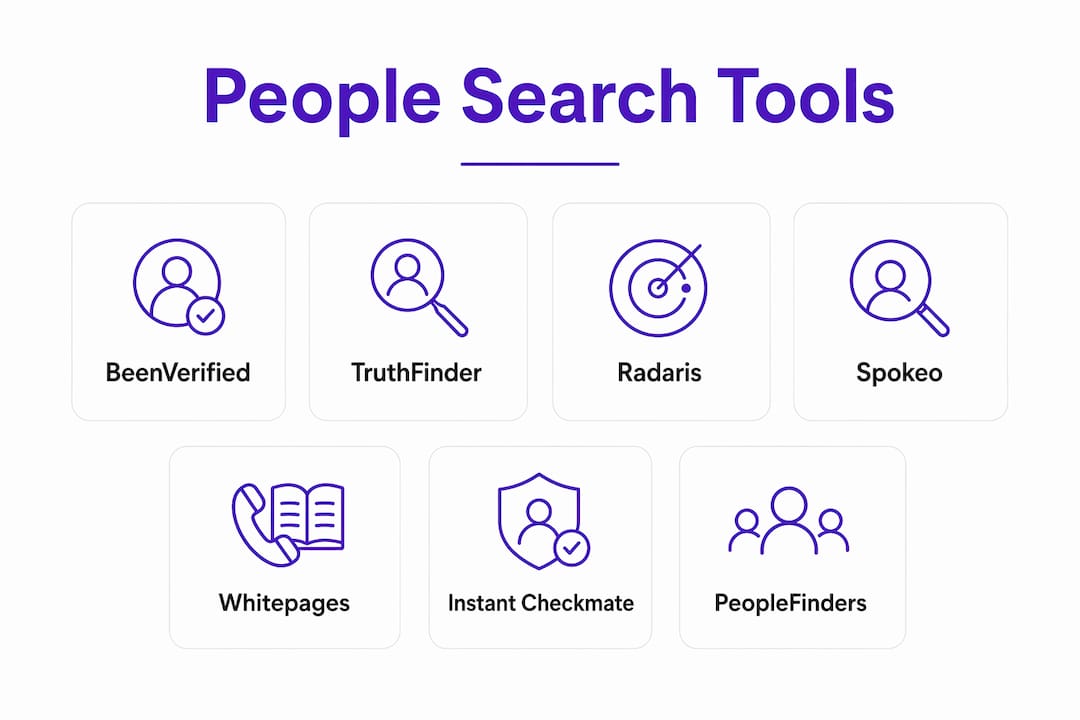
Pick your Intelius alternative by the intelligence task, not by brand recognition. For criminal and court records, TruthFinder or Instant Checkmate. For property and business data, Radaris. For broad contact and social coverage, BeenVerified or Spokeo. For reverse phone verification, Whitepages. For public-record aggregation with pay-per-report flexibility, PeopleFinders.
Quick shortlist:
- BeenVerified — all-round contact, address, and social lookups
- TruthFinder — criminal records, court filings, legal history
- Radaris — property ownership and business-linked data
- Spokeo — reverse email/phone to social profile discovery
- Whitepages — reverse phone and contact verification
- Instant Checkmate — arrest records and criminal-history depth
- PeopleFinders — pay-per-report public-record retrieval
One caveat worth stating upfront: no single tool covers every data type reliably. Cross-check critical results across at least two services, and read the trial terms before you enter a card number.
Table of Contents
- Best Intelius alternatives compared: profiles and side-by-side breakdown
- How Toolsplorer scores and selects these tools
- Toolsplorer makes this comparison faster
- FAQ
Best Intelius alternatives compared: profiles and side-by-side breakdown
Professionals consistently categorize these tools by primary strength rather than treating them as interchangeable. Here is how each one actually performs.
| Tool | Best For | Data Types | Pricing Model | Trial/Cancel Clarity | API/Integrations |
|---|---|---|---|---|---|
| BeenVerified | All-round searches | Contact, address, social, criminal | Monthly subscription | Moderate risk | Limited |
| TruthFinder | Criminal & court records | Criminal, court, contact, social | Monthly subscription | Moderate risk | None public |
| Radaris | Property & business data | Property, business, contact, public records | Monthly / pay-per-report | Low–moderate | None public |
| Spokeo | Email/phone to social | Social, contact, criminal | Monthly or pay-per-report | Low risk | None public |
| Whitepages | Reverse phone verification | Contact, address, phone | Free tier + paid plans | Low risk | API available |
| Instant Checkmate | Criminal deep dives | Criminal, court, arrest records | Monthly subscription | Moderate risk | None public |
| PeopleFinders | Public-record retrieval | Public records, contact, property | Monthly or pay-per-report | Low risk | None public |
BeenVerified covers the widest surface area for general professional use: contact details, address history, social profiles, and a criminal summary in one report. It is the right starting point when you do not yet know which data type matters most.

TruthFinder goes deeper on legal records than almost any consumer-facing service. Court filings, arrest history, and sex-offender registry checks are its core strength, which makes it the go-to for higher-risk background checks. Plans start at $4.99 for a phone lookup, making it one of the more affordable entry points for targeted checks.
Radaris is the clearest property-focused pick. Where Intelius starts from an address and works outward, Radaris surfaces ownership timelines, business registrations, and linked entities alongside contact data. Professionals doing due diligence on real estate or business counterparties will find it more useful than a general all-rounder. For context on how property data fits into open-house and networking workflows, see this 2026 open-house networking guide.
Spokeo’s standout feature is reverse lookup: feed it an email address or phone number and it maps back to social profiles and digital footprints. That makes it particularly useful for sales teams verifying lead data or investigators tracing a digital identity. You can also buy a single report without subscribing, which keeps costs low for occasional use.
Whitepages is the most utility-style option on this list. The free tier returns basic contact and location data; the paid plans add background reports. It also offers a developer API, which is rare among consumer people-search services and matters for teams that want to pipe verification into a CRM or automated workflow.
Instant Checkmate is narrower than BeenVerified but deeper on criminal data. Arrest records, mugshots, and court case details are surfaced with more granularity than most all-rounders provide. It is the right tool when a criminal history check is the primary objective, not a secondary data point.
PeopleFinders aggregates a large public-record database and lets you pay per report rather than committing to a monthly plan. For professionals who run occasional checks rather than high-volume searches, that billing model avoids the subscription trap that many Intelius users report with auto-renewal and difficult cancellation flows.
One structural note: dark-pattern UI and opaque opt-out processes are a documented risk across several people-search services. Intelius and related PeopleConnect brands route removal requests through a suppression portal that can require government-issued photo ID. Check each service’s data-removal process before you commit, especially if your team handles client data under internal privacy policies.
Modern platforms are also shifting toward real-time API integrations rather than static database snapshots. If your workflow requires live lookups or enterprise-scale volume, prioritize services with documented API access over those that offer only manual report generation.
Pro Tip: Combine one all-rounder (BeenVerified) with one specialist (TruthFinder for criminal, Radaris for property) rather than running every check through a single service. Results quality improves materially, and you avoid over-paying for data types a given tool handles poorly.
How Toolsplorer scores and selects these tools
The shortlist above is not based on star ratings alone. Toolsplorer’s AI scoring aggregates user reviews from multiple sources, cross-references vendor documentation, and weights each dimension by its practical impact on professional workflows.
| Scoring Axis | Weight | What Was Measured |
|---|---|---|
| Data accuracy & freshness | High | Report currency, user-reported outdated results |
| Trial & cancellation clarity | High | Dark-pattern risk, auto-renewal transparency |
| Privacy / data-removal process | High | Opt-out ease, ID requirements, CCPA compliance |
| API & business integrations | Medium-High | Documented API, CRM/workflow connectors |
| Pricing transparency | Medium | Published rates, hidden-fee risk |
| Report depth | Medium | Source count, document types included |
| Customer support & refund policy | Low–Medium | Response time, refund accessibility |
Accuracy and cancellation clarity carry the highest weight because customer reports consistently flag outdated results and subscription confusion as the two most common professional pain points. Privacy transparency ranks equally high as teams increasingly face internal compliance requirements around the data they pull on individuals.
API availability gets elevated weight for enterprise contexts. Real-time integrations and multi-source aggregation are what separate professional-grade tools from consumer services, and they materially affect whether a lookup can be embedded in an automated process. For teams building those pipelines, Toolsplorer’s automation category covers complementary workflow tools worth reviewing alongside people-search services.
Pro Tip: When building your own procurement checklist, treat trial cancellation clarity as a binary gate: if a service does not publish its cancellation steps clearly on its pricing page, treat that as a red flag before evaluating any other dimension.
Toolsplorer makes this comparison faster
Picking the right people-search tool from a crowded field takes time you probably do not have. Toolsplorer’s review and comparison platform aggregates scores, pricing snapshots, and integration notes across tools in this category so you can reach a decision without reading a dozen separate review sites.
What a Toolsplorer report gives you for this category:
- Aggregated user review scores weighted by recency and reviewer credibility
- Current pricing tiers and billing model flags (subscription vs. pay-per-report)
- Integration notes: which tools offer APIs and what they connect to
- Privacy and cancellation clarity ratings based on documented opt-out processes
Head to Toolsplorer’s reviews hub to pull a current comparison for any tool in this list, or browse the AI tools category if you want enrichment and data-intelligence options that go beyond traditional people-search.
FAQ
Which Intelius alternative is best for criminal records?
TruthFinder and Instant Checkmate both specialize in criminal and court data. TruthFinder also includes dark-web scan results, which Intelius does not offer.
Is there a free Intelius alternative?
Whitepages offers a free basic tier for contact and location lookups, though detailed background reports require a paid plan. Fully free services typically return limited data.
How do I avoid auto-renewal traps with people-search services?
Read the cancellation policy before entering payment details. PeopleFinders and Spokeo both offer pay-per-report options that avoid recurring subscriptions entirely.
Which tool works best for property and business due diligence?
Radaris surfaces property ownership timelines and business-linked records more reliably than general all-rounders. Intelius is also address-centric, but Radaris goes deeper on ownership history.
Can I integrate people-search results into a professional workflow?
Whitepages publishes a developer API for contact verification. For broader workflow automation, Toolsplorer’s automation tools category lists compatible integration options.
This article is general information, not legal or compliance advice. Permissible uses of people-search services in the United States are governed by the Fair Credit Reporting Act (FCRA); these tools are not FCRA-compliant consumer reporting agencies and may not be used for employment screening, tenant screening, or credit decisions. Confirm current rules with a qualified legal professional for your specific use case.